Construct IN
21 de jul. de 2026
The importance of recurring visual records in major projects
The importance of recurring visual records in major projects
Large projects require visibility into what happens in the field. Understand how recurring records help reduce uncertainty in management.
Large projects require visibility into what happens in the field. Understand how recurring records help reduce uncertainty in management.


Aline Torres
Marketing
cOMPARTILHE NAS REDES
cOMPARTILHE NAS REDES

Table of Contents
The challenge of managing what is out of sight
Information is not synonymous with visibility
What happens when the project loses its memory
The third variable in decision-making
Recurring records: from documentation to operational intelligence
A new way to monitor large projects
Managing a large construction project means dealing daily with decisions involving deadlines, quality, safety, productivity, and contractual compliance. The challenge is that these decisions are not always made by those who closely monitor the execution.
As projects become larger and more complex, the same team becomes responsible for contracts distributed across different regions and multiple work fronts simultaneously. In this context, visiting every site whenever a question arises is no longer feasible.
This reality creates a challenge that usually receives less attention than it should: how to maintain visibility over execution when it is not possible to be present everywhere it is happening?
The answer lies less in producing more information and more in ensuring that it represents the reality of execution. In large projects, what supports a decision is rarely the volume of data available, but the ability to verify what actually happened in the field.
It is precisely this challenge that is driving the adoption of technologies capable of continuously recording construction progress, creating a visual history that increases visibility of the site even from a distance.
More than documenting activities, this history preserves the context of execution and provides teams with a more reliable foundation for making decisions throughout the entire project lifecycle.
The challenge of managing what is out of sight
In industrial plants, airports, hospitals, mining, pulp and paper, or major infrastructure developments, each contract brings together dozens of companies, hundreds of professionals, and countless activities happening at the same time.
Naturally, management begins to depend on a network of people responsible for recording, communicating, and monitoring the execution. Reports, meetings, daily logs, checklists, and indicators remain indispensable, but they represent a reality known to any manager: a large part of the decisions are made without them having personally seen what is being discussed.
This dynamic is not a problem in itself. It is part of the scale of these developments. The difficulty arises when the only way to understand a situation is to rely on the interpretation of those who witnessed it.
The greater the distance between the fact and the decision, the greater the room for doubt, differing interpretations, and loss of context tend to be.
Information is not synonymous with visibility
Civil construction produces a massive amount of information throughout a project. The challenge is that not all information allows for reconstructing events when it becomes necessary.
Imagine a situation where a non-conformity is identified weeks after a certain service was performed. Or a claim where the client and the contractor need to discuss whether a field condition justified a scope change. In both cases, the conversation is rarely limited to what is written in a report.
It is necessary to understand the context of that stage of the project.
What was the environment like at that moment? What interferences existed? Had the work been executed as planned? Did the condition found in the field justify the decision made?
These questions do not always find answers in textual documents. This happens because many activities are no longer visible just a few days after being executed. Rebar is concreted, a pipeline is buried, a system is closed, a layer of backfill is covered by the next stage.
When this happens without a reliable record of the execution, the project loses part of its ability to explain its own history.
What happens when the project loses its memory
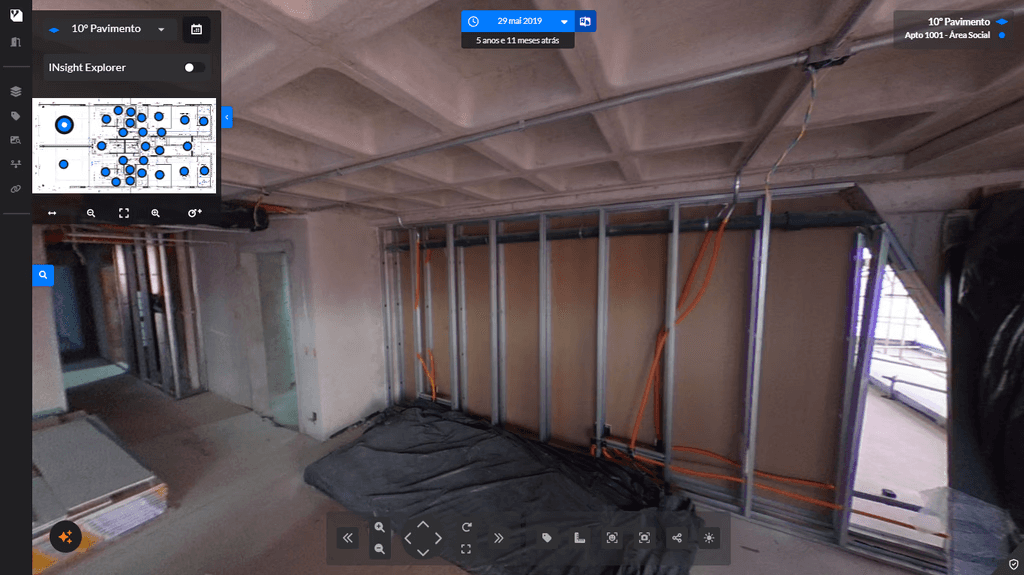
Perhaps the main function of recurring visual records is precisely to preserve the technical memory of the execution.
In long-term projects, teams may change, suppliers may be replaced, professionals may take on new responsibilities, or there may simply be no recorded evidence. Months later, when a discussion about quality, productivity, or contractual compliance arises, it is not always possible to identify what happened.
Without evidence, management becomes dependent on people's memory.
This scenario directly impacts contract management and the relationship with the client. In large projects, many disputes do not arise because a service was not executed, but because it is no longer possible to demonstrate how it was executed.
Some stages simply disappear as the work progresses. Pipelines are buried, rebar is concreted, electrical installations are hidden behind walls and ceilings, drainage systems are no longer visible.
When a question arises about the conformity of the execution, little remains besides reports, Daily Logs, lost images, and other documentary records. If that moment was not visually recorded in an organized manner, demonstrating that the service was executed as planned becomes much more difficult.
This has a direct impact on claims, non-conformities, and technical investigations, which then rely on reconstructions made weeks or months after execution. It also affects construction productivity, as decisions may be delayed while teams search for information, perform new inspections, or mobilize people just to verify a specific site condition.
In this context, recurring visual evidence ceases to be just a way to document the project. They strengthen technical documentation, support measurements, discussions, contract amendments, and contribute to a more transparent relationship between the client and the contractor, based on verifiable facts rather than just the interpretation of those who monitored the execution.
The third variable in decision-making
Every decision on site is born from the combination of different sources of information.
Reports help to understand what happened. References, such as designs, contracts, schedules, and BIM models, show what should have happened.
In recent years, however, a third variable has begun to play a leading role: evidence.
This is the logic that underlies Reality Capture:
Report + Reference + Evidence = Evaluation → Decision
The value of this equation lies precisely in the balance between its elements.
Reports remain indispensable for contextualizing a situation. References establish technical and contractual criteria. Evidence, on the other hand, allows for verifying the execution as it actually occurred, reducing the subjectivity of the analyses.
The greater the complexity of the project, the greater the importance of this third variable tends to be.
Recurring records: from documentation to operational intelligence
Recording a project has always been part of the construction routine.
The difference is that today it is no longer enough to produce isolated photographs or store images without context.
What gains relevance is the ability to build a continuous visual history of the execution.
Technologies such as 360° cameras, drones, and laser scanning allow for recording different moments of the project with varying levels of detail. When these records are organized over time and integrated with other project information, they stop serving only for reference and start supporting management.
A manager can review stages already completed without relying exclusively on the memory of the teams. A contractual dispute can be analyzed based on the conditions existing at that time. A non-conformity can be investigated considering the evolution of the execution, and not just its final outcome.
The gain is not just in the possibility of viewing the site remotely, but of understanding its evolution based on organized evidence.
A new way to monitor large projects
For a long time, project management accepted that some decisions were made based on reports, occasional visits, and documents produced after the events occurred. This model was sufficient for a context in which developments were less distributed, contracts were less complex, and the need for traceability was smaller.
Today, this reality has changed.
Managing large projects requires more than monitoring indicators or receiving periodic updates. It requires reliable access to the context in which each decision was made.
It is in this scenario that recurring visual records stop being just a documentation resource and start playing a strategic role with several benefits:
More control over complexities and the various fronts involved;
Fewer costs with contract amendments and project measurements;
Strengthening of contract management;
Preservation of the project's memory;
Reduction of uncertainties;
Bringing decision-makers closer to the reality of execution, even miles away.
In the end, the discussion is perhaps not about incorporating yet another technology to the job site.
The most important question is another: how many decisions made in your operation today could be faster, more reliable, and better founded if it were possible to return to the facts whenever necessary?
Want to deepen your knowledge on evidence-based construction management?
Access exclusive content on our blog: https://constructin.com.br/blog/gestao-de-obras-tradicional-ou-baseada-em-evidencias-o-que-sustenta-as-decisoes-no-canteiro
To learn more about Reality Capture solutions, fill out the form below:
Table of Contents
The challenge of managing what is out of sight
Information is not synonymous with visibility
What happens when the project loses its memory
The third variable in decision-making
Recurring records: from documentation to operational intelligence
A new way to monitor large projects
Managing a large construction project means dealing daily with decisions involving deadlines, quality, safety, productivity, and contractual compliance. The challenge is that these decisions are not always made by those who closely monitor the execution.
As projects become larger and more complex, the same team becomes responsible for contracts distributed across different regions and multiple work fronts simultaneously. In this context, visiting every site whenever a question arises is no longer feasible.
This reality creates a challenge that usually receives less attention than it should: how to maintain visibility over execution when it is not possible to be present everywhere it is happening?
The answer lies less in producing more information and more in ensuring that it represents the reality of execution. In large projects, what supports a decision is rarely the volume of data available, but the ability to verify what actually happened in the field.
It is precisely this challenge that is driving the adoption of technologies capable of continuously recording construction progress, creating a visual history that increases visibility of the site even from a distance.
More than documenting activities, this history preserves the context of execution and provides teams with a more reliable foundation for making decisions throughout the entire project lifecycle.
The challenge of managing what is out of sight
In industrial plants, airports, hospitals, mining, pulp and paper, or major infrastructure developments, each contract brings together dozens of companies, hundreds of professionals, and countless activities happening at the same time.
Naturally, management begins to depend on a network of people responsible for recording, communicating, and monitoring the execution. Reports, meetings, daily logs, checklists, and indicators remain indispensable, but they represent a reality known to any manager: a large part of the decisions are made without them having personally seen what is being discussed.
This dynamic is not a problem in itself. It is part of the scale of these developments. The difficulty arises when the only way to understand a situation is to rely on the interpretation of those who witnessed it.
The greater the distance between the fact and the decision, the greater the room for doubt, differing interpretations, and loss of context tend to be.
Information is not synonymous with visibility
Civil construction produces a massive amount of information throughout a project. The challenge is that not all information allows for reconstructing events when it becomes necessary.
Imagine a situation where a non-conformity is identified weeks after a certain service was performed. Or a claim where the client and the contractor need to discuss whether a field condition justified a scope change. In both cases, the conversation is rarely limited to what is written in a report.
It is necessary to understand the context of that stage of the project.
What was the environment like at that moment? What interferences existed? Had the work been executed as planned? Did the condition found in the field justify the decision made?
These questions do not always find answers in textual documents. This happens because many activities are no longer visible just a few days after being executed. Rebar is concreted, a pipeline is buried, a system is closed, a layer of backfill is covered by the next stage.
When this happens without a reliable record of the execution, the project loses part of its ability to explain its own history.
What happens when the project loses its memory
Perhaps the main function of recurring visual records is precisely to preserve the technical memory of the execution.
In long-term projects, teams may change, suppliers may be replaced, professionals may take on new responsibilities, or there may simply be no recorded evidence. Months later, when a discussion about quality, productivity, or contractual compliance arises, it is not always possible to identify what happened.
Without evidence, management becomes dependent on people's memory.
This scenario directly impacts contract management and the relationship with the client. In large projects, many disputes do not arise because a service was not executed, but because it is no longer possible to demonstrate how it was executed.
Some stages simply disappear as the work progresses. Pipelines are buried, rebar is concreted, electrical installations are hidden behind walls and ceilings, drainage systems are no longer visible.
When a question arises about the conformity of the execution, little remains besides reports, Daily Logs, lost images, and other documentary records. If that moment was not visually recorded in an organized manner, demonstrating that the service was executed as planned becomes much more difficult.
This has a direct impact on claims, non-conformities, and technical investigations, which then rely on reconstructions made weeks or months after execution. It also affects construction productivity, as decisions may be delayed while teams search for information, perform new inspections, or mobilize people just to verify a specific site condition.
In this context, recurring visual evidence ceases to be just a way to document the project. They strengthen technical documentation, support measurements, discussions, contract amendments, and contribute to a more transparent relationship between the client and the contractor, based on verifiable facts rather than just the interpretation of those who monitored the execution.
The third variable in decision-making
Every decision on site is born from the combination of different sources of information.
Reports help to understand what happened. References, such as designs, contracts, schedules, and BIM models, show what should have happened.
In recent years, however, a third variable has begun to play a leading role: evidence.
This is the logic that underlies Reality Capture:
Report + Reference + Evidence = Evaluation → Decision
The value of this equation lies precisely in the balance between its elements.
Reports remain indispensable for contextualizing a situation. References establish technical and contractual criteria. Evidence, on the other hand, allows for verifying the execution as it actually occurred, reducing the subjectivity of the analyses.
The greater the complexity of the project, the greater the importance of this third variable tends to be.
Recurring records: from documentation to operational intelligence
Recording a project has always been part of the construction routine.
The difference is that today it is no longer enough to produce isolated photographs or store images without context.
What gains relevance is the ability to build a continuous visual history of the execution.
Technologies such as 360° cameras, drones, and laser scanning allow for recording different moments of the project with varying levels of detail. When these records are organized over time and integrated with other project information, they stop serving only for reference and start supporting management.
A manager can review stages already completed without relying exclusively on the memory of the teams. A contractual dispute can be analyzed based on the conditions existing at that time. A non-conformity can be investigated considering the evolution of the execution, and not just its final outcome.
The gain is not just in the possibility of viewing the site remotely, but of understanding its evolution based on organized evidence.
A new way to monitor large projects
For a long time, project management accepted that some decisions were made based on reports, occasional visits, and documents produced after the events occurred. This model was sufficient for a context in which developments were less distributed, contracts were less complex, and the need for traceability was smaller.
Today, this reality has changed.
Managing large projects requires more than monitoring indicators or receiving periodic updates. It requires reliable access to the context in which each decision was made.
It is in this scenario that recurring visual records stop being just a documentation resource and start playing a strategic role with several benefits:
More control over complexities and the various fronts involved;
Fewer costs with contract amendments and project measurements;
Strengthening of contract management;
Preservation of the project's memory;
Reduction of uncertainties;
Bringing decision-makers closer to the reality of execution, even miles away.
In the end, the discussion is perhaps not about incorporating yet another technology to the job site.
The most important question is another: how many decisions made in your operation today could be faster, more reliable, and better founded if it were possible to return to the facts whenever necessary?
Want to deepen your knowledge on evidence-based construction management?
Access exclusive content on our blog: https://constructin.com.br/blog/gestao-de-obras-tradicional-ou-baseada-em-evidencias-o-que-sustenta-as-decisoes-no-canteiro
To learn more about Reality Capture solutions, fill out the form below:
Sobre o autor
Aline Torres
Marketing
Formada em Marketing e com especialização em Gestão de Marketing, atua com estratégia de conteúdo, SEO e planejamento editorial desde 2015. Atualmente é Analista de Conteúdo na Construct IN, construtech que oferece plataforma para gestão e documentação de obras por meio de captura da realidade.
cOMPARTILHE NAS REDES
Recomendado para você
carregar mais ↓


Subscribe to our newsletter
Explore nossas soluções
Entre em contato e descubra como a captura da realidade e dados centralizados podem ser a solução para a gestão de suas obras.
