
Construct IN
10 de jul. de 2026


Aline Torres
Marketing

Construction management is, essentially, a decision-making process. Every day, engineers, coordinators, managers, and directors need to evaluate information to approve execution stages, validate measurements, identify deviations, prioritize actions, and direct teams.
The greater the complexity of the project, the greater the impact of the quality of these decisions on schedule, cost, productivity, and quality.
Despite this, few companies reflect on a very simple question: what supports the decisions made on the construction site?
In this article you will understand:
How traditional construction management works
What reports are in construction management
What references are and what their role is in execution
What the limits of deciding based only on reports and references are
What evidence-based management is
What characterizes evidence in civil construction
How this model transforms decision-making
The role of Reality Capture in this new model
In most companies operating with traditional management, the answer for decisions is anchored in two sources of information: reports and references.
Reports record what teams observed during the execution of the work. References show how the construction should happen, according to the planning.
This combination has accompanied civil construction for decades and remains indispensable for any project.
Over the last few years, however, a new model has begun to gain ground in construction management. Instead of supporting decisions solely on reports and references, companies have begun to incorporate a third layer of information: evidence.
In this article, you will understand how the logic of traditional management works, what its limitations are, and why evidence-based management is changing the way construction is monitored.
The equation of traditional construction management
Many of the decisions made on a site follow a logic that is rarely consciously perceived.
Whenever a manager needs to understand the status of a project, validate an activity, or identify a problem, they seek information to build their analysis.
In traditional construction management, this process can be represented by a very simple equation:
Reports + References -> Decision Making
By comparing these two sources, managers monitor execution, evaluate deviations, and make decisions daily.
This model has been part of the civil construction routine for decades and continues to be the basis of construction management in most companies.
To understand its limits, first it is important to understand exactly what reports and references are.
What are reports in construction management?
A report is all information produced by people to describe what happened at the construction site.
This type of record is present in the routine of any project and can take different formats, such as:
construction reports;
site diaries;
checklists;
emails;
audios;
messages in apps;
in-person or virtual meetings.
These records play an essential role in management. They are what document events, record decisions, communicate progress, and allow different teams to share information about the execution.
At the same time, reports have an inherent characteristic: they represent the perception of whoever followed a certain situation.
This means that two professionals can observe the same environment and produce different descriptions of what happened: one may highlight the progress of the activity, another may call attention to an interference found during execution. Both reports may be correct, but each presents its own reading of that context.
This characteristic does not reduce the importance of reports. On the contrary, they remain indispensable for construction management. The point is that they record only a snippet or an interpretation of reality.
Imagine that an engineer states in a report that a certain installation has been completed. This report communicates the progress of the activity, but it hardly answers questions such as:
In what conditions was the environment?
Were there interferences between disciplines?
Was the service up to standard?
Were there stored materials that could compromise the next stage?
Without another source of information, these answers usually depend on the memory of the teams or a new visit to the site.
What are references in construction management?
If reports show what happened according to the teams' perception, references show how the work should happen.
They guide the execution and establish the criteria used to monitor the project throughout all its stages.
Among the main references used in construction management are:
executive projects;
BIM models;
schedules;
budgets;
executive planning;
technical specifications.
These documents work as the basis of planning. They organize activities, define deadlines, establish quality standards, and indicate the expected result for each stage of the work.
Just like reports, references are indispensable for good management. However, they represent what was planned, and not what actually happened during execution.
When a manager compares reports with references, they can verify if the information recorded by the teams is aligned with what had been predicted for the work.
This analysis allows for the identification of delays, validation of completed stages, and monitoring of the development of the project.
But, still, there is an important limitation in this management model, which becomes more evident as projects grow in scale, complexity, and number of involved teams.
Learn more about management that integrates BIM models and real images of the construction site
The limit of management based only on reports and references
As we have already discussed, reports and references are indispensable for construction management. The challenge is not in the existence of these two sources of information, but in the fact that they cannot, by themselves, represent the reality of execution.
Reports show what teams observed during the work. References show what was planned for that execution.
Between these two layers lies a gap: what actually happened on the construction site.
In practice, this difference appears more frequently than it seems.
Imagine that a team records in a report that a certain area is ready to receive the next stage of the work. The schedule confirms that the activity should have already been completed and the project indicates exactly how it should be executed.
At first glance, all information seems consistent. But, when visiting the environment, the manager finds stored materials that prevent the progress of the next team, an interference between installations that still needs to be resolved, or small execution deviations that had not been recorded.
None of these situations mean there was an error in the report or a flaw in the planning, they just demonstrate that there is a difference between describing a construction project and observing it.
The larger the development, the greater the number of teams, suppliers, disciplines, and work fronts acting simultaneously. As a consequence, the difficulty of maintaining a shared vision of what is actually happening in each environment also increases.
It is precisely at this point that a new way to support decision-making arises.
Evidence-based management
Evidence-based management maintains everything that already exists in traditional management: reports continue to be important, schedules continue to guide execution, projects and BIM models continue to be the main technical references of the work.
The difference is that a new layer of information becomes part of the management process: evidence.
In civil construction, evidence is reliable records of the reality of the work, organized so that they can be consulted later whenever necessary.
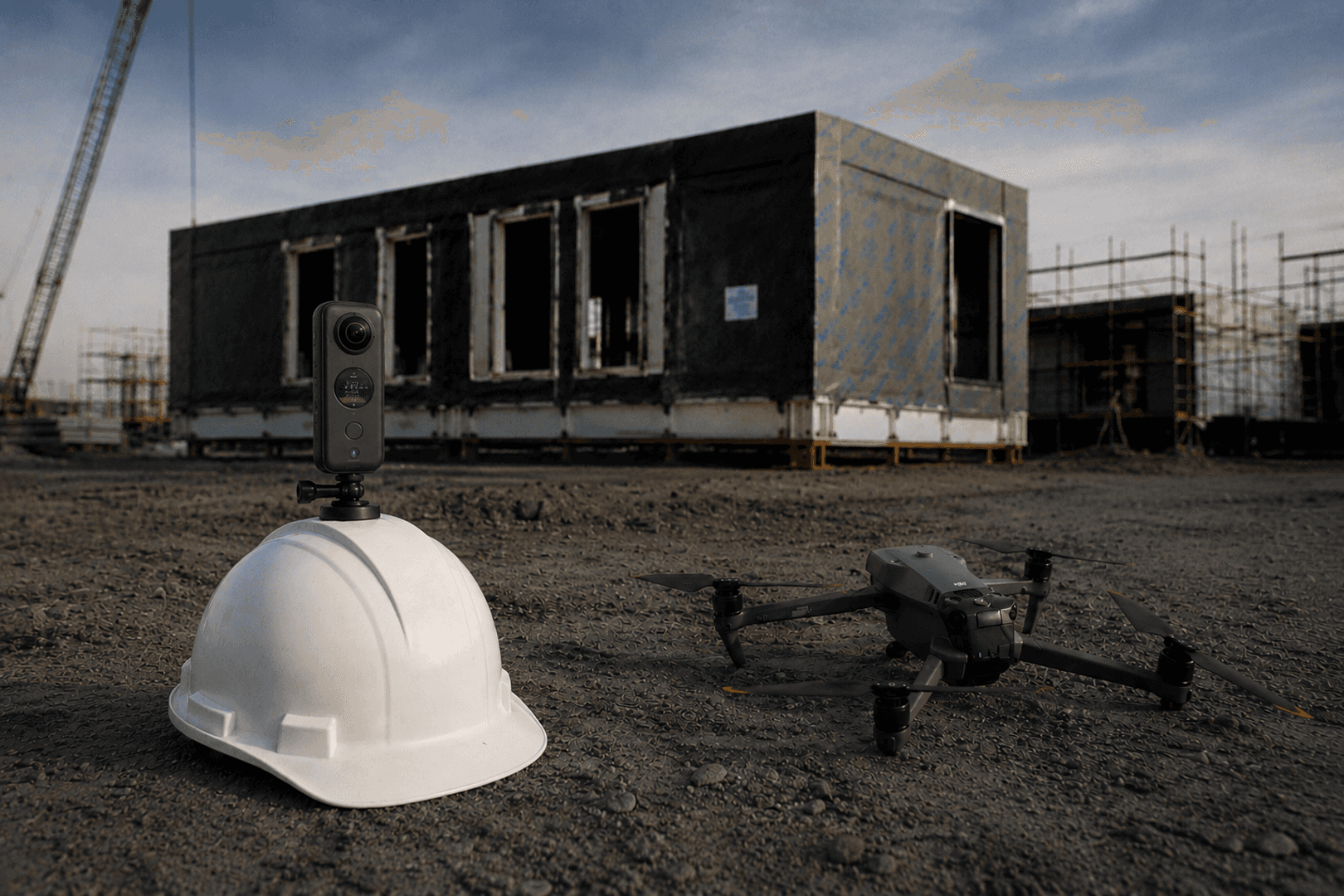
These records can be obtained by different Reality Capture technologies, such as:
360° images;
drone mapping;
3D scans;
point clouds.
Unlike isolated photographs, these records preserve the context of the environment.
Instead of showing only a detail of the execution, they allow for a much more complete understanding of the situation of that space, enabling the manager to virtually return to the environment to analyze conditions, validate information, and clarify doubts even days or weeks after the capture.
This characteristic changes how information is used throughout the work.
The new equation of construction management
When evidence becomes part of management, the logic of decision-making also evolves.
The equation stops being:
Reports + References -> Decision Making
and becomes:
Reports + References + Evidence -> Evaluation -> Decision Making
In practice, this means that decisions stop depending exclusively on what was planned and what was reported by the teams. Planning, execution, and reality start to be analyzed together.
Everyone consults the same database of evidence to understand the context of the work and validate information with greater security.
This model reduces divergent interpretations, facilitates alignment between teams, and strengthens the decision-making process. Not because it eliminates people's experience or replaces existing documents, but because it expands the quantity and quality of information available for analysis.
How evidence-based management improves decision-making
In a project, a decision rarely depends on a single piece of information. Typically, managers need to gather different elements to understand a situation before acting.
When a team reports that a certain activity has been completed, for example, the manager can check the daily reports, consult the schedule to verify if that stage was planned, analyze the project or BIM model to confirm technical requirements, and, finally, access the visual records of the site to verify under what conditions that environment was at the moment of capture.
This combination allows decisions to be made with much more context.
In practice, evidence-based management contributes to:
validating executed services with greater security;
comparing planning and execution in an objective way;
identifying interferences before they generate rework;
monitoring the physical evolution of the work;
recording important milestones of the project;
strengthening communication between teams and stakeholders;
preserving a reliable history of execution.
Instead of reconstructing events through dispersed reports, everyone starts analyzing the same representation of the reality of the work.
How does this happen in practice?
Imagine that a builder is executing dozens of construction projects in different cities.
In a weekly meeting, the manager in charge receives reports indicating the progress of each unit, consults the schedule, and checks which deliveries should have been completed by that date.
In traditional management, any doubt usually requires new phone calls, exchanging messages, or even a face-to-face visit to confirm the situation.
In evidence-based management, there is a third source of information available. In addition to reports and references, the manager can consult the visual records of that environment, understand the context of execution, compare what was captured with planning, and validate information without depending exclusively on the perception of whoever was present at the location.
This makes the tracking process more consistent, especially in operations with several simultaneous construction sites or teams distributed in different regions.
The main change is not in the speed of the decision, but in the quality of the information that supports that decision.
Check out the testimony of those who are already part of this transformation:
What supports your construction decisions?
Throughout this article, we saw that traditional construction management is supported by the combination of reports and references. This model continues to be essential for any project, but it is no longer sufficient to answer, on its own, the demands of increasingly complex and distributed construction works.
As new professionals participate in decisions, more information needs to be shared, and different work fronts evolve simultaneously, understanding only what was planned and what was reported stops offering all the necessary context to evaluate a situation.
It is in this scenario that evidence-guided management gains space. By incorporating reliable records of the reality of the work into the management process, it allows analyzing planning, execution, and context from the same information base, making decisions more consistent and reducing subjective interpretations.
Reports show what people said happened. References show what was supposed to happen. Evidence shows what actually happened.
In the end, the transformation is not just in adopting a new technology, but in how information starts to support every decision made throughout the project.
Because, when reality is also part of the analysis, deciding stops being an exercise in interpretation and becomes an evidence-based process.
Want to understand how Reality Capture helps companies build evidence-based management? Fill out the form below and find out how Visi centralizes 360° images, drone mapping, BIM models, and other construction information in a single platform.
Sobre o autor
Aline Torres
Marketing
Formada em Marketing e com especialização em Gestão de Marketing, atua com estratégia de conteúdo, SEO e planejamento editorial desde 2015. Atualmente é Analista de Conteúdo na Construct IN, construtech que oferece plataforma para gestão e documentação de obras por meio de captura da realidade.
cOMPARTILHE NAS REDES
Recomendado para você
carregar mais ↓



Subscribe to our newsletter
Explore nossas soluções
Entre em contato e descubra como a captura da realidade e dados centralizados podem ser a solução para a gestão de suas obras.
