Construct IN
5 de jun. de 2026


Aline Torres
Marketing
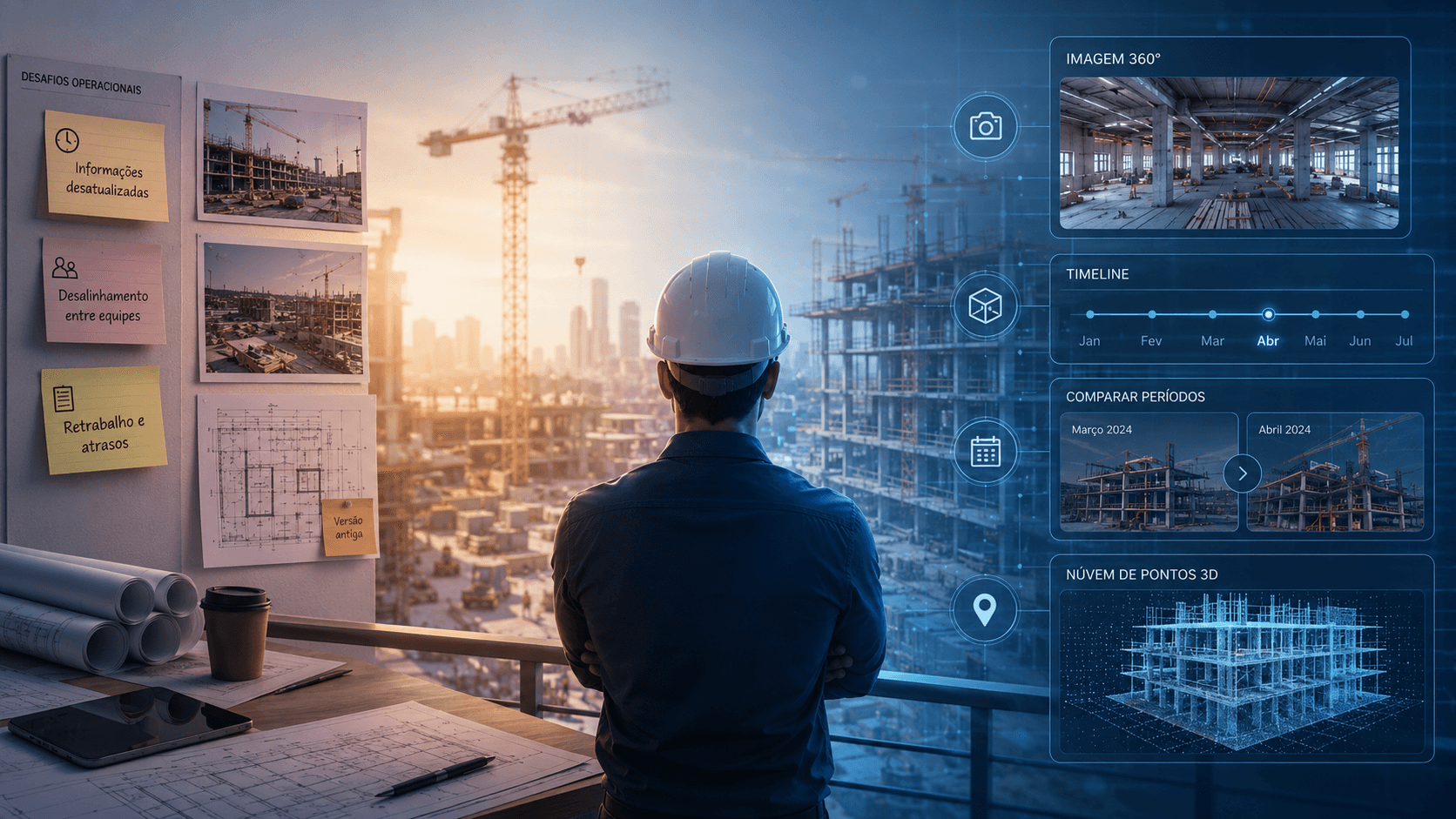
At some point in your career, you have probably participated in a meeting where a seemingly simple question arose: “When did this happen?”.
It could have been an interference between disciplines, a execution discrepancy, a service that needed to be redone, or a delay in a specific work front. The problem begins when no one can answer with confidence.
At that moment, teams look for old photographs, review reports, consult messaging groups, and try to reconstruct events from the memory of the people involved. What should be an objective analysis turns into a search for scattered information.
Although this situation is common in construction, its impacts go far beyond operational discomfort. The difficulty of proving what happened in the field directly affects the ability to control schedules, reduce rework, and make decisions quickly.
As projects become more complex and operations more distributed, the availability of reliable evidence increasingly influences business outcomes.
When a lack of information causes delays
Most delays do not arise from a single critical event. In many cases, they are the consequence of problems that remain invisible during part of the execution.
When an occurrence is identified quickly, teams can typically adjust planning, reorganize activities, and limit its impacts. The scenario changes when the problem is only noticed after other fronts have already advanced or when different teams have started working with divergent information.
For many project management specialists, the ability to detect deviations early is one of the factors that most influence project predictability. The greater the interval between the occurrence of a problem and its identification, the lower the capacity to correct it without significant impacts on schedule, productivity, and cost tends to be.
In addition, the lack of structured records makes it difficult to validate the actual physical progress of the work. It is not uncommon for the client, construction company, and field teams to have different interpretations of the real stage of execution of certain activities, creating noise that affects planning, measurements, and decision-making.
The financial impact goes beyond rework
When talking about losses associated with a lack of visibility, rework is usually the most remembered example. And there are good reasons for that.
According to estimates widely used by the Construction Industry Institute (CII), rework can represent between 5% and 15% of the total value of a project, depending on the type of enterprise and the level of maturity of the management processes. In many cases, problems are identified only after other activities have already been executed over the affected area.
However, costs are not limited to correcting the service. The late discovery of a problem can generate rescheduling of teams, extension of contracts, remobilization of suppliers, and an increase in indirect costs of the project. Depending on the stage of execution, a relatively simple occurrence can trigger disproportionate financial impacts.
For companies that operate with the expansion of retail chains, logistics centers, or industrial operations, there is an additional factor: the delay in starting operations. In these scenarios, each lost day can represent a postponement of revenue, impact growth goals, and a reduction in the speed of return on investment.
Why multi-site operations face an even greater challenge
Controlling a construction site already requires a significant amount of information. Controlling dozens of them simultaneously is a challenge of another scale.
Managers responsible for expansion programs usually depend on periodic visits, monitoring reports, and updates sent by local teams. While these mechanisms are important, they cannot always keep up with the pace of changes happening daily in the field.
Furthermore, different professionals record information in different ways. What one team considers sufficient evidence may not meet the needs of someone making decisions in another state or even another country.
As a consequence, many managers end up spending excessive time validating information before being able to act on it. Instead of discussing solutions, meetings are dedicated to confirming what actually happened.
Evidence is also a risk management tool
Construction constantly deals with technical, operational, and contractual risks. In this context, the availability of reliable records directly influences the capacity for analysis and decision-making.
When a divergence arises related to scope, schedule, or responsibility for a certain occurrence, reconstructing the history of the project becomes fundamental. However, without consistent documentation, this analysis depends on fragmented and, often, contradictory sources.
The report Construction Disconnected, produced by Autodesk in partnership with FMI Corporation, points out that problems related to communication and information management are among the main causes of productivity loss and rework in the sector.
For this reason, companies with greater digital maturity have directed efforts to improve not only the circulation of information but also the quality of the records produced during execution. The more reliable the available evidence base, the greater the capacity to identify causes, justify decisions, and reduce uncertainties tends to be.
The role of Reality Capture in this scenario
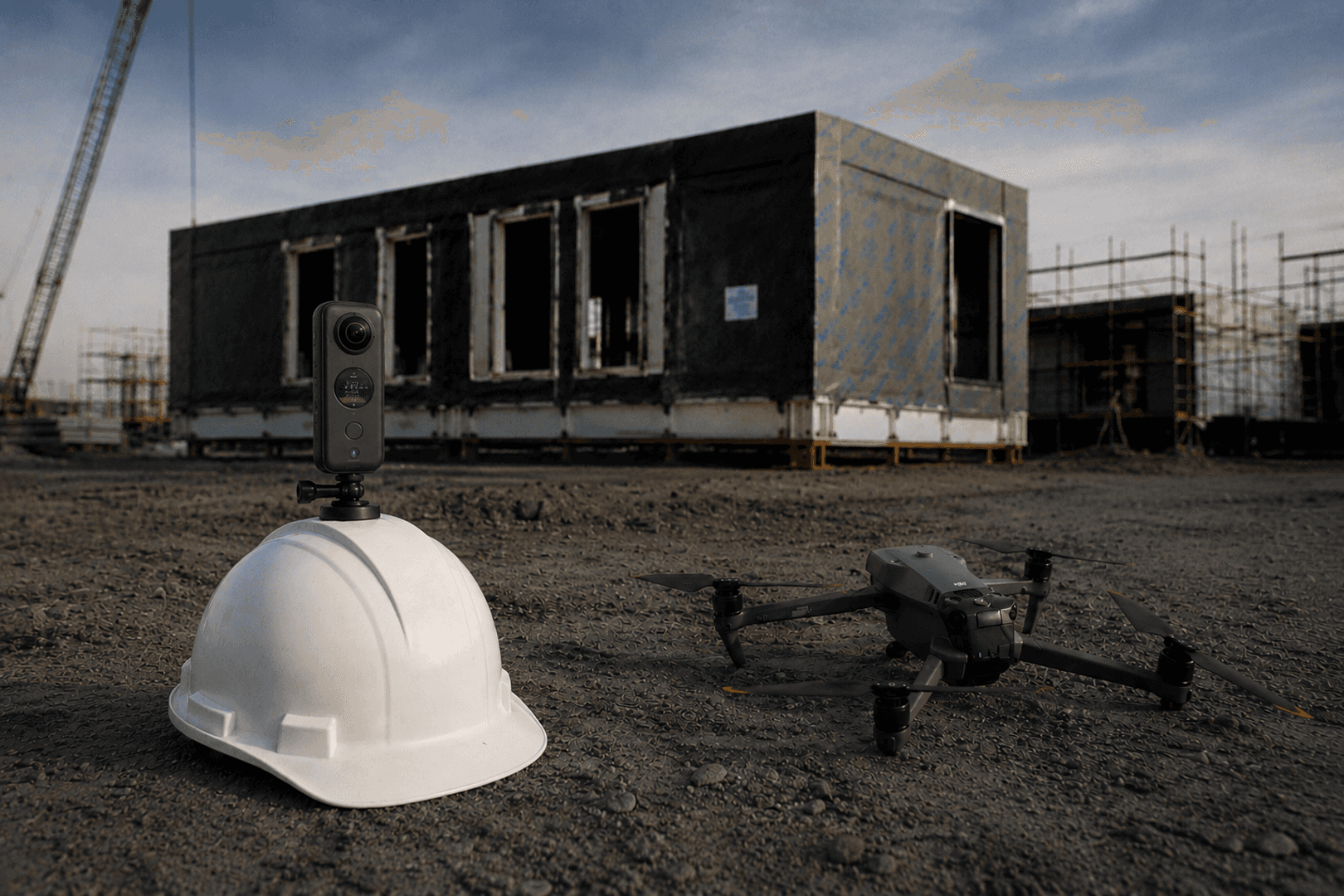
In recent years, Reality Capture technologies have come to occupy an increasingly relevant space in the construction management strategy. 360° cameras, drones, and 3D scanning allow registering the actual conditions of a project with higher frequency and detail than traditional monitoring methods.
Learn more about this topic in the Reality Capture in Brazil Report 2025-2026
In practice, this type of evidence expands the teams' ability to consult the project's history, compare different periods, and verify conditions that would often go undocumented in conventional records.
This type of information also contributes to a more objective analysis of execution. Instead of relying exclusively on reports and references of how the project should be, managers can access visual and spatial evidence that helps understand the context of a specific occurrence.
“We avoided demolishing two whole walls because the system alerted us that the piping was already out of position." (Engineer from a Real Estate Developer in São Paulo)
For geographically distributed operations, the benefit is even more relevant. The possibility of remotely monitoring the progress of the projects reduces dependence on frequent travel and facilitates the standardization of monitoring across different units.
A new chapter in construction management
For decades, the construction industry has learned to live with delays, rework, and disputes over what happened on a construction site. Many of these situations have come to be treated as a natural part of the activity.
But it's worth reflecting: how many problems could have been avoided if they had been identified a week earlier? Or even a few days earlier?
As Reality Capture technologies evolve, the discussion shifts from just documenting a project to the speed at which teams can identify deviations, understand their causes, and act before the impacts spread to other fronts.
If you want to better understand how this works in practice, we have prepared a Reality Capture Guide that presents the main technologies used today, their applications in construction, and the benefits observed by companies that have already incorporated this approach into their management processes.
Sobre o autor
Aline Torres
Marketing
Formada em Marketing e com especialização em Gestão de Marketing, atua com estratégia de conteúdo, SEO e planejamento editorial desde 2015. Atualmente é Analista de Conteúdo na Construct IN, construtech que oferece plataforma para gestão e documentação de obras por meio de captura da realidade.
cOMPARTILHE NAS REDES
Recomendado para você
carregar mais ↓



Subscribe to our newsletter
Explore nossas soluções
Entre em contato e descubra como a captura da realidade e dados centralizados podem ser a solução para a gestão de suas obras.
