
Construct IN
22 de mai. de 2026
Modular construction: 3 reasons to use Reality Capture in offsite projects
Modular construction: 3 reasons to use Reality Capture in offsite projects
Factory, logistics, assembly, and field operations happening at the same time: understand why offsite construction demands more operational visibility.
Factory, logistics, assembly, and field operations happening at the same time: understand why offsite construction demands more operational visibility.


Aline Torres
Marketing
cOMPARTILHE NAS REDES
cOMPARTILHE NAS REDES
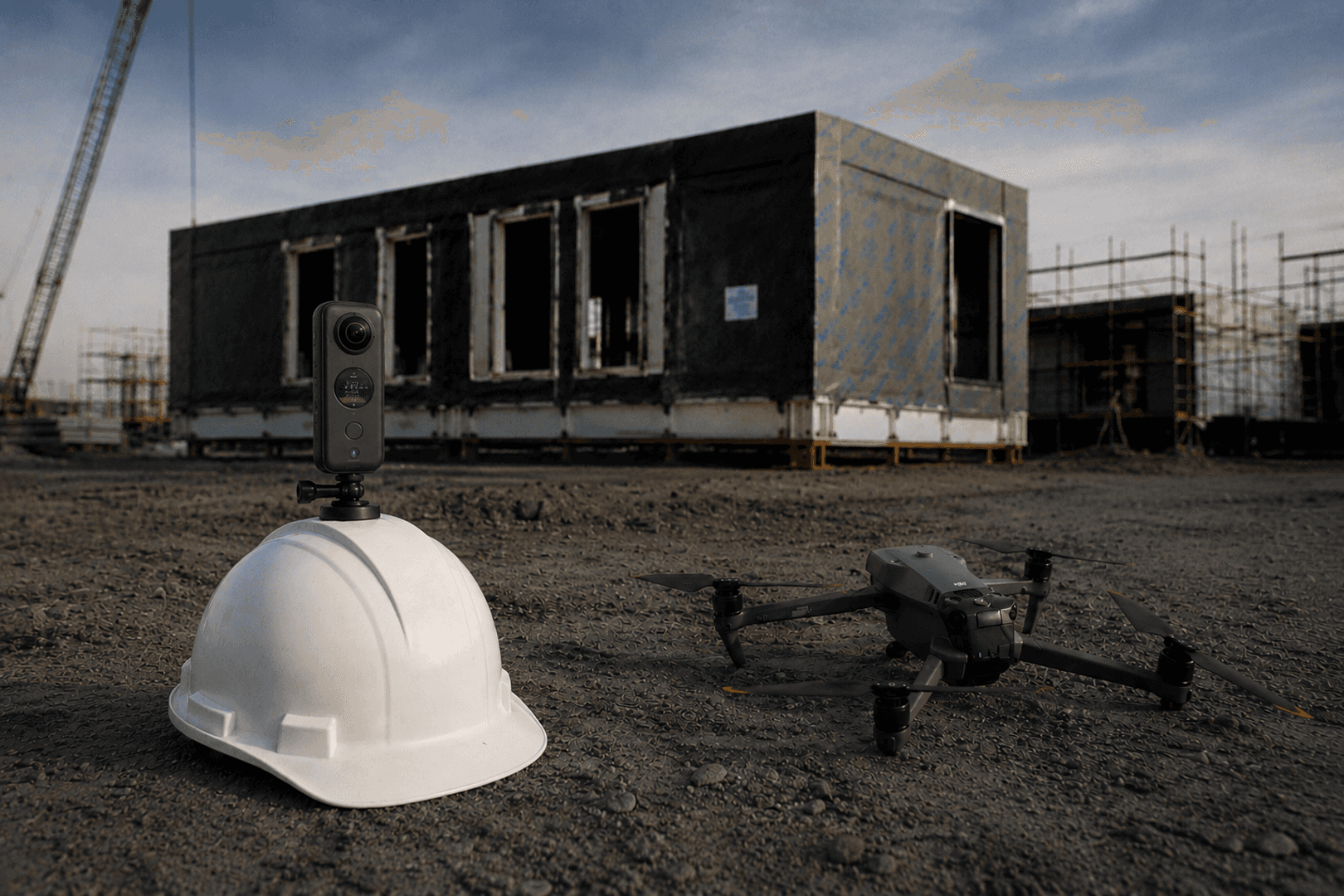
The industrialization of construction has been accelerating the digital transformation in the sector. In modular operations, the challenge lies not only in executing faster, but in coordinating multiple production fronts with precision, traceability, and predictability.
Unlike conventional construction sites, where most of the management is concentrated on-site, offsite projects depend on continuous integration between the factory, logistics, assembly, installations, and finishing. This means that a large part of the operational risks is no longer solely in the structural execution and now also exists at the interfaces between disciplines, in compliance control, in synchronization between stages, and in the validation of what was actually delivered in the field.
Industrialized, modular, and offsite construction: what is the difference?
Although the terms are frequently used as synonyms, they have important differences.
Industrialized construction is the broadest concept and involves the application of more standardized, scalable, and productivity-oriented processes within civil construction.
The offsite model, on the other hand, refers to the execution of part of the work outside the traditional construction site, in controlled environments, with subsequent transportation and on-site assembly.
Modular construction, in turn, is a type of offsite construction in which complete modules of the building are produced beforehand in a factory and installed at the final location.
Despite the operational differences, all of these models share the same challenge: ensuring speed, visibility, traceability, and control over execution.
In this context, Reality Capture has been gaining ground as one of the main allies of offsite operations. Technologies such as 360º cameras, drones, and 3D laser scanning (Point Cloud) transform the field into a continuous source of visual and technical data, creating a layer of operational traceability that simply did not exist before.
The advancement of digitalization
According to a Deloitte report, construction companies that advance in digitalization can significantly improve their operational control capacity, collaboration between teams, and predictability of execution, especially in complex and distributed projects.
On the other hand, Autodesk points out that more than 30% of construction professionals still waste more than one day per week searching for project information or validating conflicting data between teams.
In offsite operations, where compressed schedules and parallel operations are part of the routine, this problem tends to be even more sensitive.
1. Offsite projects require continuous traceability
In traditional onsite construction, most of the monitoring happens directly on-site. The manager can view the structural progress, monitor teams in person, and validate activities in a relatively linear sequence.
In the offsite model, however, the operational logic changes completely.
While part of the project is being executed in the field, modules may be manufactured simultaneously at another location. Electrical and plumbing installations often leave the factory partially completed. Finishing work can happen even before the final assembly of the structure. In many cases, different suppliers operate in parallel within the same production chain.
This creates a significant challenge: how to ensure traceability over everything that is happening?
Without continuous visibility of the operation, the risks of the following increase:
misalignment between factory and construction site;
assembly failures;
incompatibilities between disciplines;
rework in installations;
discrepancies between as-built and design;
logistical delays;
compliance and technical acceptance issues.
This is exactly where Reality Capture gains relevance.
Structured visual record of the operation
With 360º images, drones, and digitized technical records, the construction site now has a continuous history of execution. Instead of relying solely on isolated photos or in-person visits, managers can document critical stages with spatial context and traceability.
This is especially relevant in modular operations, where the validation of assembly, technical interfaces, and execution standards is part of the project's success.
Evidence for validation and compliance
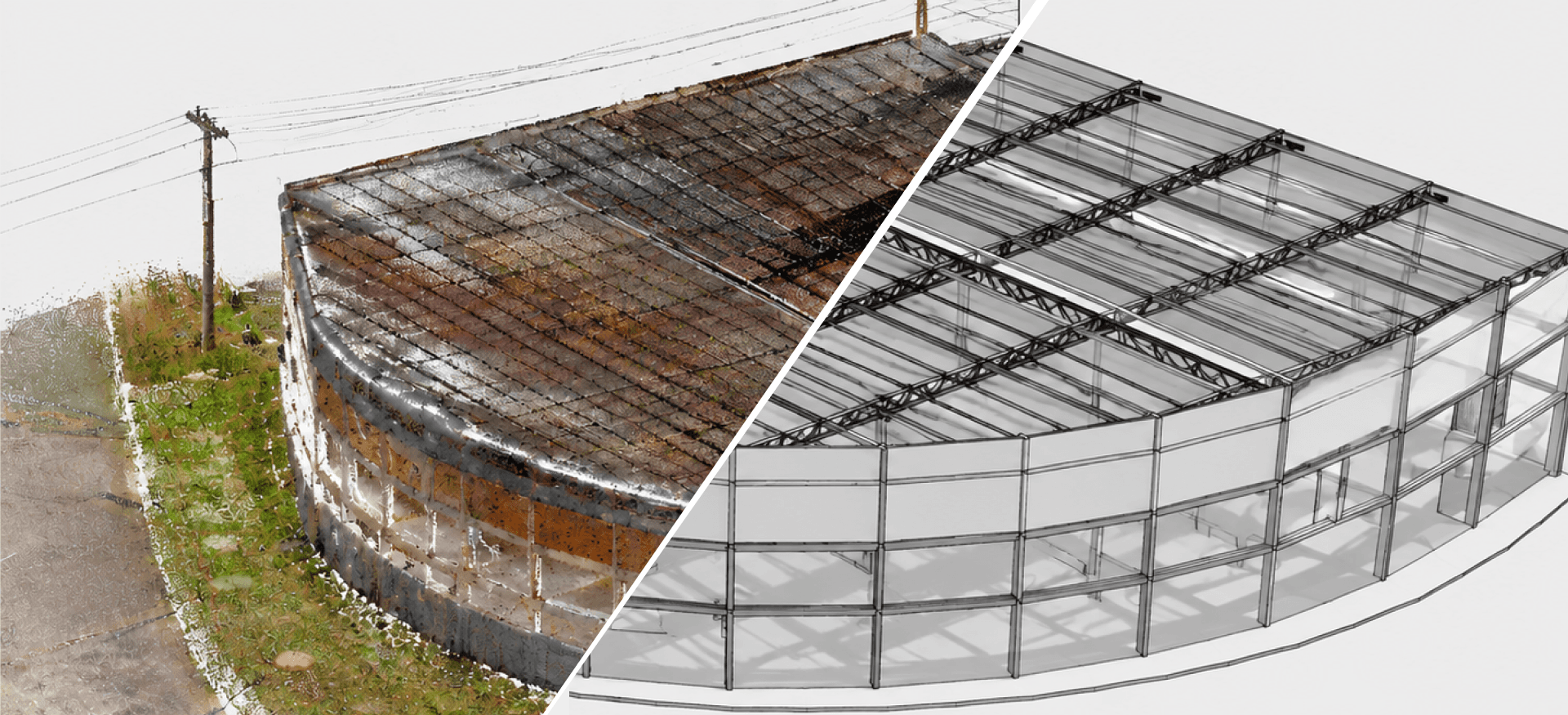
In addition to visual documentation, technologies like Laser Scanning allow for the generation of highly precise three-dimensional models of what was built.
In practice, this makes it possible to:
validate positioning;
check for interferences;
compare as-built with design;
record execution compliance;
reduce technical disputes between teams.
In hospital, retail operations, and standardized expansion projects, this layer of traceability helps ensure consistency between units and greater control over final quality.
2. Remote monitoring of industrialized construction is no longer optional
Modular construction brought significant productivity gains, but it also increased operational complexity.
Today, many companies simultaneously manage:
multiple construction sites;
different suppliers;
distributed operations;
outsourced factories;
extremely compressed schedules.
In this scenario, relying exclusively on on-site monitoring limits management capacity.
According to a FMI Corporation study, more than 35% of construction professionals' time is still consumed by non-productive activities related to searching for, validating, or updating information. In distributed operations, this impact tends to grow.
Less travel, more operational context
In offsite operations, remote monitoring has been gaining relevance as schedules become more accelerated and different fronts start happening simultaneously.
360º images, drones, and 3D laser scanning help create more complete records of execution conditions, assembly, and physical progress of the operation.
As a result, validation, alignment, and monitoring activities happen with more operational consistency, reducing dependence on constant visits and facilitating communication between engineering, operations, and suppliers.
Simultaneous management of multiple units
This gain becomes even more relevant in expansion projects.
Retail chains, hospitals, laboratories, and standardized operations frequently execute multiple units at the same time. Without digitalization, maintaining operational consistency across these projects becomes extremely difficult.
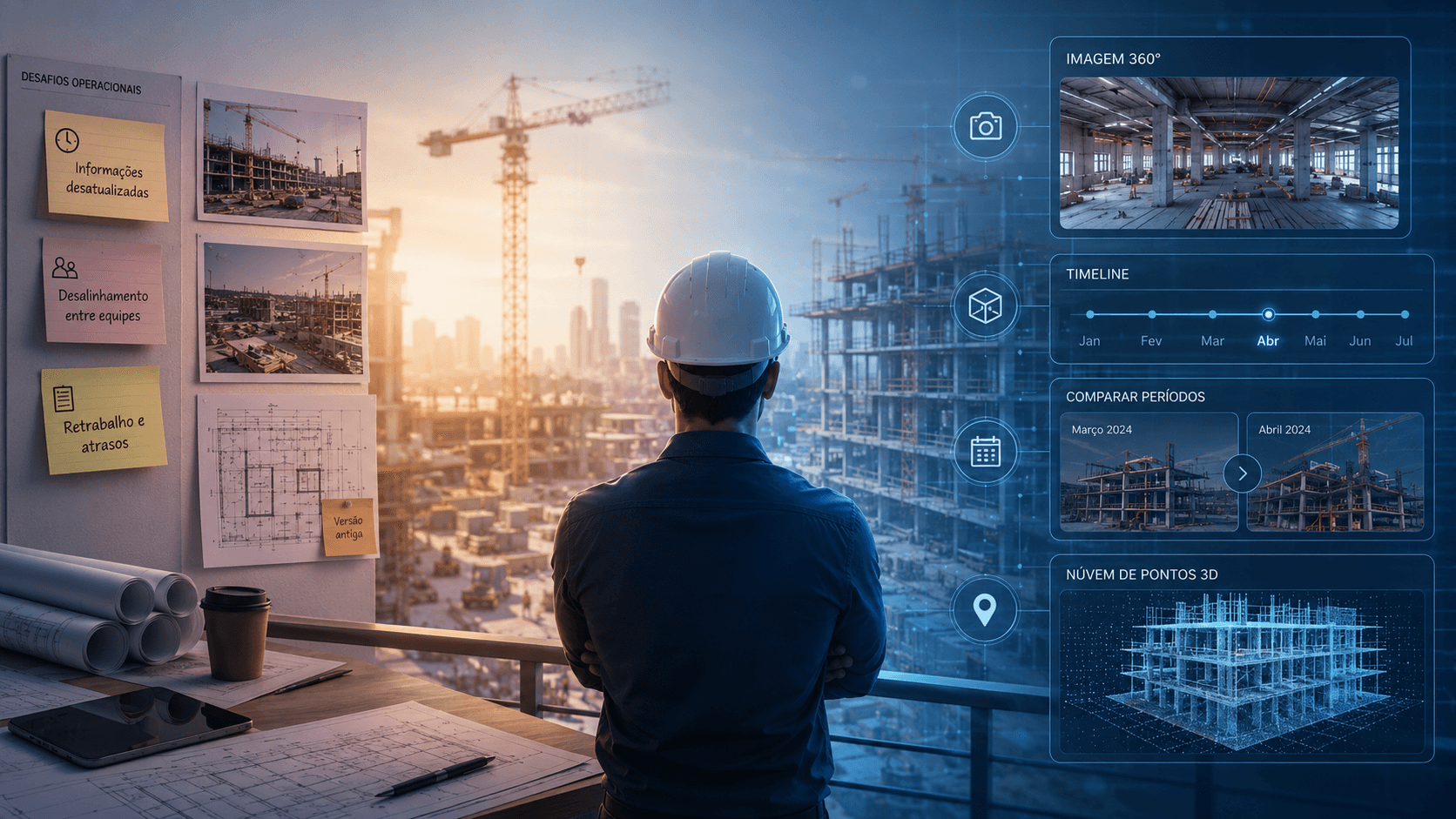
By centralizing visual and technical records on a digital platform, managers can compare executions, validate standards, and monitor different units without losing visibility of the operation.
Enjoying the content?
Check out the panel featuring Brasil ao Cubo, about Reality Capture in modular construction:
3. Predictability has become a competitive differentiator
In industrialized construction, productivity depends directly on synchronization.
When there is little visibility into what is actually happening in the field, decisions end up being made reactively. The result usually appears in the form of rework, delay, logistical waste, and lost productivity.
According to KPMG global research, only 31% of construction projects manage to complete their activities within 10% of the initially planned budget.
In offsite construction, where steps depend on each other in a much more integrated way, minor failures can generate exponentially larger impacts.
Early identification of deviations
Reality Capture helps anticipate problems before they progress to more critical stages.
With continuous monitoring and structured technical history, teams can:
identify execution deviations;
validate actual physical progress;
check compliance;
reduce ambiguities between teams;
make decisions faster.
In the case of 3D laser scanning, for example, comparing as-built with design allows for the detection of incompatibilities before final assembly, reducing rework and operational risks.
More predictability for scalable operations
The larger the scale of the operation, the greater the impact of predictability.
Companies working with rapid expansion need to ensure standardization across units, quality of execution, and operational speed at the same time. Without structured visibility from the field, scaling this model becomes much more difficult.
For this reason, Reality Capture is no longer just a documentation tool and is taking on a strategic role in the management of industrialized construction.
The role of technology in integrating construction site, factory, and management
Capturing data is only part of the challenge. In this construction model, the true gain happens when this information is organized, accessible, and connected to decision-making.
It is in this context that platforms like Visi by Construct IN gain relevance.
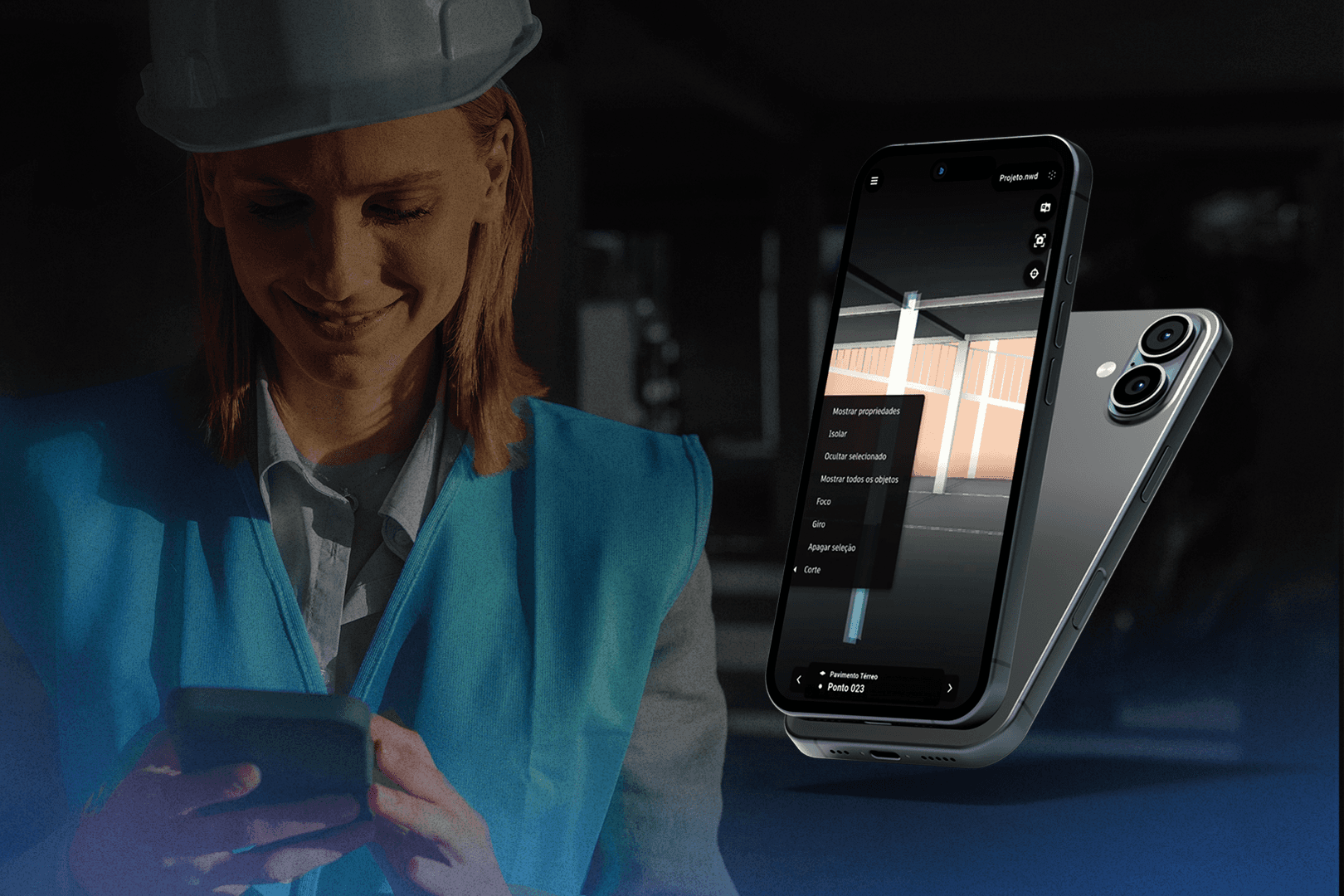
Visi centralizes Reality Capture with 360º images, drone mapping, and point clouds in a single environment, allowing companies to monitor construction sites, validate executions, and create operational traceability on a large scale.
For modular operations and expansion projects, this means more control over schedules, easier monitoring of multiple units, and greater agility in communication between technical teams, operations, and management.
The meeting point for offsite
This advancement of digitalization is also taking center stage at major industry events.
The Expo Offsite, considered the largest modular construction fair in Latin America, has reinforced how topics such as traceability, integration between construction site and factory, and data-driven management are at the core of offsite construction's evolution.
During the 2026 edition, Construct IN will present practical Reality Capture applications for modular construction at its booth, including technologies such as 360º cameras, drones, Laser Scanning (Point Cloud), and an autonomous robot for field data capture.
Additionally, Kelvin Montini, Partner and Marketing Director of Construct IN, will also participate in the Arena Expo Offsite schedule with the lecture “Reality Capture and Point Cloud Applied to Offsite Models”, addressing how companies are utilizing digitalization and traceability to expand operational control, predictability, and efficiency in industrialized projects.
More than just accelerating projects, industrialization requires smarter, more connected, and more predictable operations. And this only happens when decision-making stops relying on isolated perceptions and starts being built on real execution data.
In the end, digitalizing industrialized construction sites does not just mean seeing the field better; it means creating the operational capacity to scale with control.
“The Construct IN ecosystem eliminated data fragmentation. With the digitalization of construction sites, we obtain greater traceability and cost reduction.” (Luiz Eduardo Pillar, Engineering Director at Brasil ao Cubo)
Want to understand how Construct IN has been supporting companies in the sector to increase operational visibility, reduce rework, and gain predictability in modular and offsite projects?
Talk to our specialists and discover how Reality Capture is being applied in faster, more distributed, and more complex projects.
The industrialization of construction has been accelerating the digital transformation in the sector. In modular operations, the challenge lies not only in executing faster, but in coordinating multiple production fronts with precision, traceability, and predictability.
Unlike conventional construction sites, where most of the management is concentrated on-site, offsite projects depend on continuous integration between the factory, logistics, assembly, installations, and finishing. This means that a large part of the operational risks is no longer solely in the structural execution and now also exists at the interfaces between disciplines, in compliance control, in synchronization between stages, and in the validation of what was actually delivered in the field.
Industrialized, modular, and offsite construction: what is the difference?
Although the terms are frequently used as synonyms, they have important differences.
Industrialized construction is the broadest concept and involves the application of more standardized, scalable, and productivity-oriented processes within civil construction.
The offsite model, on the other hand, refers to the execution of part of the work outside the traditional construction site, in controlled environments, with subsequent transportation and on-site assembly.
Modular construction, in turn, is a type of offsite construction in which complete modules of the building are produced beforehand in a factory and installed at the final location.
Despite the operational differences, all of these models share the same challenge: ensuring speed, visibility, traceability, and control over execution.
In this context, Reality Capture has been gaining ground as one of the main allies of offsite operations. Technologies such as 360º cameras, drones, and 3D laser scanning (Point Cloud) transform the field into a continuous source of visual and technical data, creating a layer of operational traceability that simply did not exist before.
The advancement of digitalization
According to a Deloitte report, construction companies that advance in digitalization can significantly improve their operational control capacity, collaboration between teams, and predictability of execution, especially in complex and distributed projects.
On the other hand, Autodesk points out that more than 30% of construction professionals still waste more than one day per week searching for project information or validating conflicting data between teams.
In offsite operations, where compressed schedules and parallel operations are part of the routine, this problem tends to be even more sensitive.
1. Offsite projects require continuous traceability
In traditional onsite construction, most of the monitoring happens directly on-site. The manager can view the structural progress, monitor teams in person, and validate activities in a relatively linear sequence.
In the offsite model, however, the operational logic changes completely.
While part of the project is being executed in the field, modules may be manufactured simultaneously at another location. Electrical and plumbing installations often leave the factory partially completed. Finishing work can happen even before the final assembly of the structure. In many cases, different suppliers operate in parallel within the same production chain.
This creates a significant challenge: how to ensure traceability over everything that is happening?
Without continuous visibility of the operation, the risks of the following increase:
misalignment between factory and construction site;
assembly failures;
incompatibilities between disciplines;
rework in installations;
discrepancies between as-built and design;
logistical delays;
compliance and technical acceptance issues.
This is exactly where Reality Capture gains relevance.
Structured visual record of the operation
With 360º images, drones, and digitized technical records, the construction site now has a continuous history of execution. Instead of relying solely on isolated photos or in-person visits, managers can document critical stages with spatial context and traceability.
This is especially relevant in modular operations, where the validation of assembly, technical interfaces, and execution standards is part of the project's success.
Evidence for validation and compliance
In addition to visual documentation, technologies like Laser Scanning allow for the generation of highly precise three-dimensional models of what was built.
In practice, this makes it possible to:
validate positioning;
check for interferences;
compare as-built with design;
record execution compliance;
reduce technical disputes between teams.
In hospital, retail operations, and standardized expansion projects, this layer of traceability helps ensure consistency between units and greater control over final quality.
2. Remote monitoring of industrialized construction is no longer optional
Modular construction brought significant productivity gains, but it also increased operational complexity.
Today, many companies simultaneously manage:
multiple construction sites;
different suppliers;
distributed operations;
outsourced factories;
extremely compressed schedules.
In this scenario, relying exclusively on on-site monitoring limits management capacity.
According to a FMI Corporation study, more than 35% of construction professionals' time is still consumed by non-productive activities related to searching for, validating, or updating information. In distributed operations, this impact tends to grow.
Less travel, more operational context
In offsite operations, remote monitoring has been gaining relevance as schedules become more accelerated and different fronts start happening simultaneously.
360º images, drones, and 3D laser scanning help create more complete records of execution conditions, assembly, and physical progress of the operation.
As a result, validation, alignment, and monitoring activities happen with more operational consistency, reducing dependence on constant visits and facilitating communication between engineering, operations, and suppliers.
Simultaneous management of multiple units
This gain becomes even more relevant in expansion projects.
Retail chains, hospitals, laboratories, and standardized operations frequently execute multiple units at the same time. Without digitalization, maintaining operational consistency across these projects becomes extremely difficult.
By centralizing visual and technical records on a digital platform, managers can compare executions, validate standards, and monitor different units without losing visibility of the operation.
Enjoying the content?
Check out the panel featuring Brasil ao Cubo, about Reality Capture in modular construction:
3. Predictability has become a competitive differentiator
In industrialized construction, productivity depends directly on synchronization.
When there is little visibility into what is actually happening in the field, decisions end up being made reactively. The result usually appears in the form of rework, delay, logistical waste, and lost productivity.
According to KPMG global research, only 31% of construction projects manage to complete their activities within 10% of the initially planned budget.
In offsite construction, where steps depend on each other in a much more integrated way, minor failures can generate exponentially larger impacts.
Early identification of deviations
Reality Capture helps anticipate problems before they progress to more critical stages.
With continuous monitoring and structured technical history, teams can:
identify execution deviations;
validate actual physical progress;
check compliance;
reduce ambiguities between teams;
make decisions faster.
In the case of 3D laser scanning, for example, comparing as-built with design allows for the detection of incompatibilities before final assembly, reducing rework and operational risks.
More predictability for scalable operations
The larger the scale of the operation, the greater the impact of predictability.
Companies working with rapid expansion need to ensure standardization across units, quality of execution, and operational speed at the same time. Without structured visibility from the field, scaling this model becomes much more difficult.
For this reason, Reality Capture is no longer just a documentation tool and is taking on a strategic role in the management of industrialized construction.
The role of technology in integrating construction site, factory, and management
Capturing data is only part of the challenge. In this construction model, the true gain happens when this information is organized, accessible, and connected to decision-making.
It is in this context that platforms like Visi by Construct IN gain relevance.
Visi centralizes Reality Capture with 360º images, drone mapping, and point clouds in a single environment, allowing companies to monitor construction sites, validate executions, and create operational traceability on a large scale.
For modular operations and expansion projects, this means more control over schedules, easier monitoring of multiple units, and greater agility in communication between technical teams, operations, and management.
The meeting point for offsite
This advancement of digitalization is also taking center stage at major industry events.
The Expo Offsite, considered the largest modular construction fair in Latin America, has reinforced how topics such as traceability, integration between construction site and factory, and data-driven management are at the core of offsite construction's evolution.
During the 2026 edition, Construct IN will present practical Reality Capture applications for modular construction at its booth, including technologies such as 360º cameras, drones, Laser Scanning (Point Cloud), and an autonomous robot for field data capture.
Additionally, Kelvin Montini, Partner and Marketing Director of Construct IN, will also participate in the Arena Expo Offsite schedule with the lecture “Reality Capture and Point Cloud Applied to Offsite Models”, addressing how companies are utilizing digitalization and traceability to expand operational control, predictability, and efficiency in industrialized projects.
More than just accelerating projects, industrialization requires smarter, more connected, and more predictable operations. And this only happens when decision-making stops relying on isolated perceptions and starts being built on real execution data.
In the end, digitalizing industrialized construction sites does not just mean seeing the field better; it means creating the operational capacity to scale with control.
“The Construct IN ecosystem eliminated data fragmentation. With the digitalization of construction sites, we obtain greater traceability and cost reduction.” (Luiz Eduardo Pillar, Engineering Director at Brasil ao Cubo)
Want to understand how Construct IN has been supporting companies in the sector to increase operational visibility, reduce rework, and gain predictability in modular and offsite projects?
Talk to our specialists and discover how Reality Capture is being applied in faster, more distributed, and more complex projects.
Sobre o autor
Aline Torres
Marketing
Formada em Marketing e com especialização em Gestão de Marketing, atua com estratégia de conteúdo, SEO e planejamento editorial desde 2015. Atualmente é Analista de Conteúdo na Construct IN, construtech que oferece plataforma para gestão e documentação de obras por meio de captura da realidade.
cOMPARTILHE NAS REDES
Recomendado para você
carregar mais ↓


Subscribe to our newsletter
Explore nossas soluções
Entre em contato e descubra como a captura da realidade e dados centralizados podem ser a solução para a gestão de suas obras.
