Construct IN
17 de jun. de 2026


Aline Torres
Marketing

The digitalization of civil construction has advanced significantly over the last decade. BIM models, digital schedules, management platforms, ERP systems, drones, 360º cameras, and three-dimensional scanning technologies have become part of the routine for many projects.
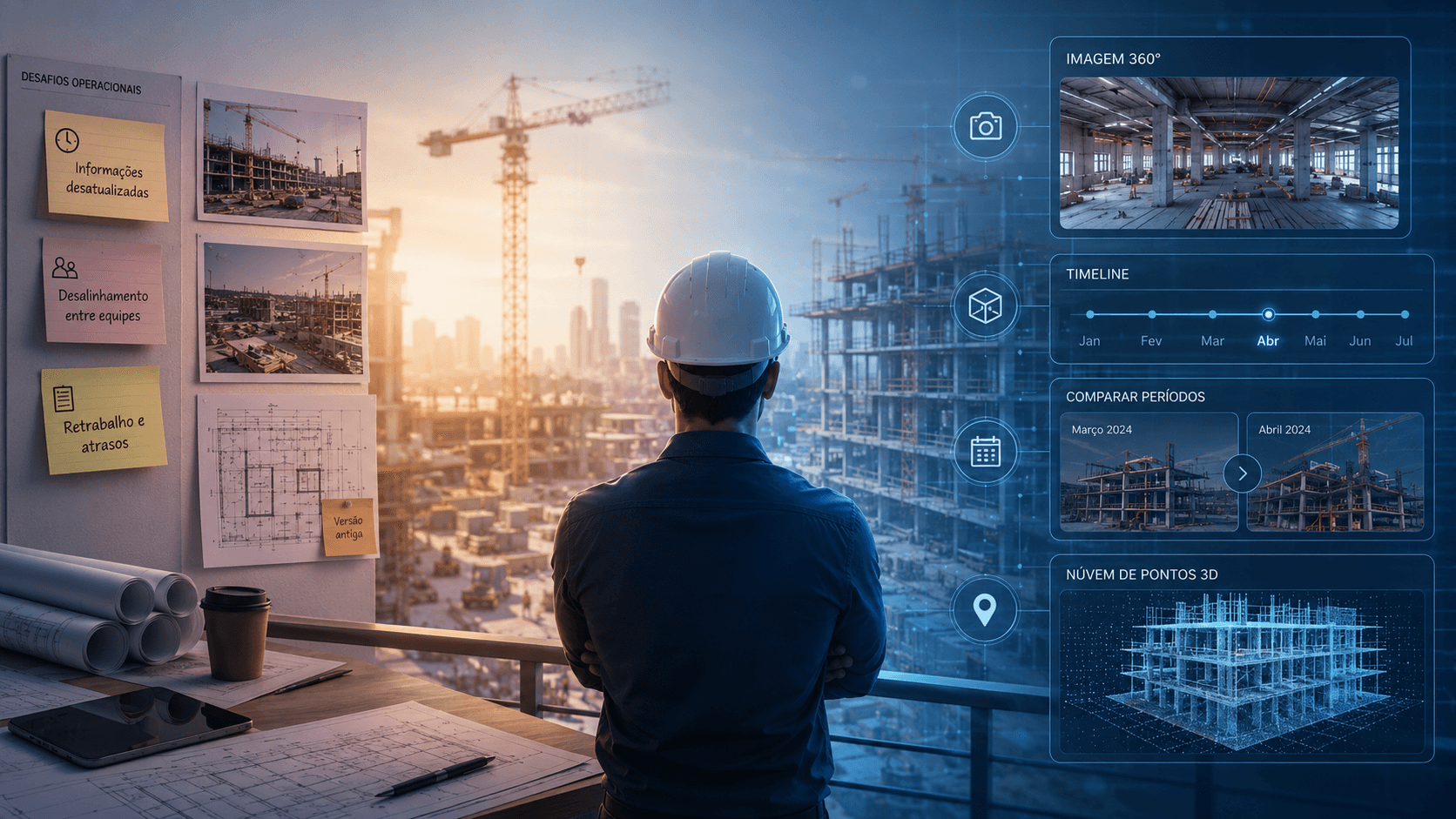
Despite this, a challenge remains present in a large part of construction works: the fragmentation of information.
It is common for projects and BIM models to be stored in environments like Autodesk Construction Cloud, Autodesk Docs, or corporate servers. Schedules are kept in software such as Primavera P6 or Microsoft Project. Budgets remain in ERPs and specialized systems. Reports are generated in PDFs. Photos and videos are stored in shared folders. Messages, operational clarifications, and informal records circulate via WhatsApp, Microsoft Teams, or email.
The result is a scenario in which there is an increasing amount of information available, but an equally growing difficulty in connecting this information and using it to support decision-making.
This challenge is not just operational. It has a direct impact on productivity, quality, schedule, and cost.
According to a study conducted by Autodesk in partnership with the FMI consulting firm, construction professionals spend approximately 35% of their time on non-productive activities, including searching for information, resolving data conflicts, and rework resulting from communication failures. The same study estimates that problems related to information and communication generated over $177 billion in annual losses for the construction industry.
The problem, therefore, is not the lack of data. It is the difficulty of turning data into context.
BIM provides the reference. But the construction happens in the field.
The adoption of BIM brought significant gains to the sector.
Three-dimensional models enriched with information allow for improved design coordination, support planning processes, and reduce risks during execution.
However, BIM remains a representation of what should exist. It serves as a technical reference for the construction work.
To assess physical progress, compliance, deviations, or actual execution conditions, it is necessary to compare this reference with evidence produced in the field. It is precisely at this point that visual records play a strategic role.
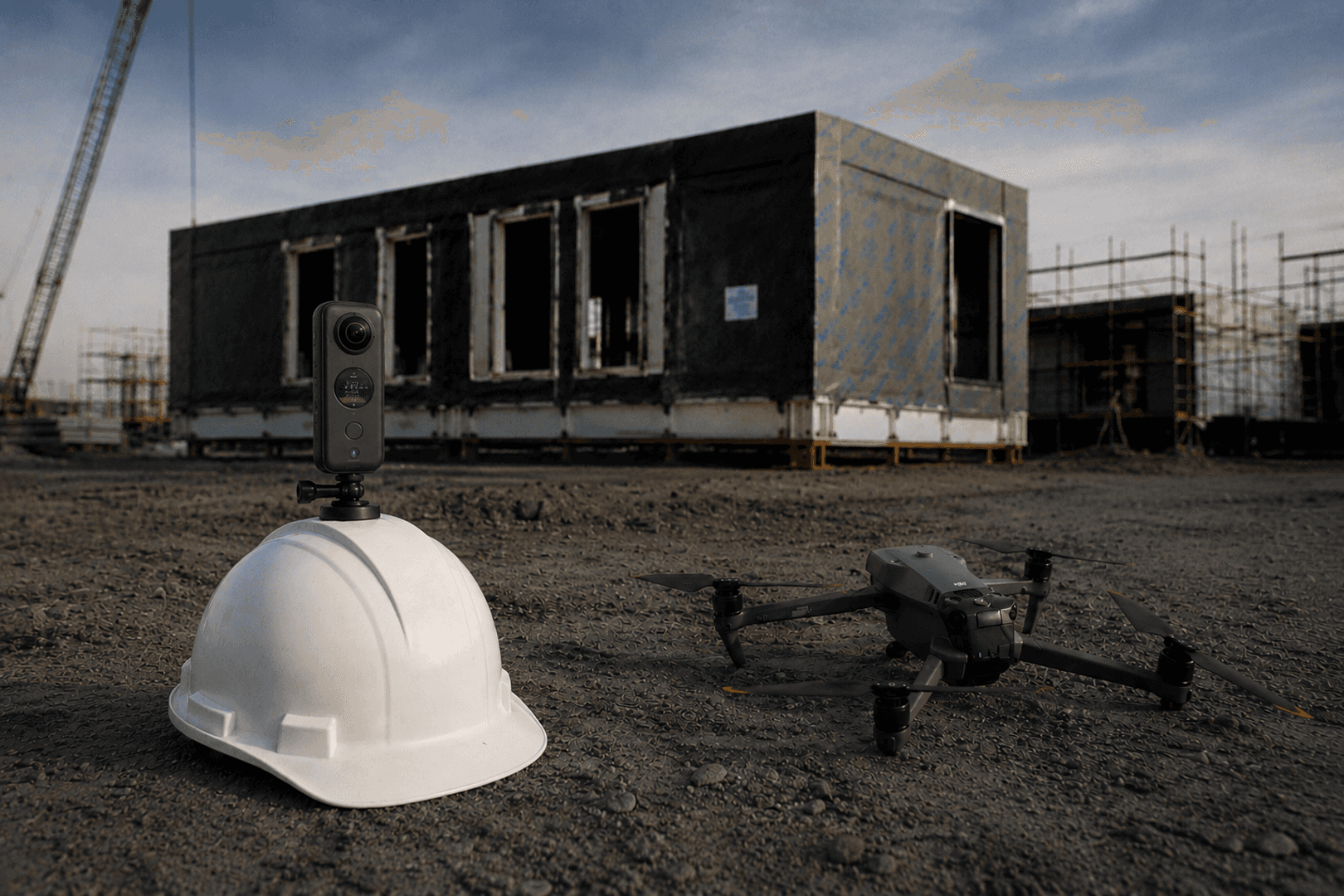
Images captured by 360º cameras allow for the documentation of indoor environments with a high level of detail and temporal traceability. Meanwhile, aerial images captured by drones provide a comprehensive view of the project, allowing for the monitoring of physical evolution, site utilization, logistics, and general execution conditions.
In situations that require greater geometric precision, laser scanner surveys or photogrammetry can generate point clouds capable of representing the actual conditions of the construction site in three dimensions.
Each of these technologies generates valuable information. However, when they remain isolated, they require the user to consult different platforms and make correlations between multiple information sources to understand a given construction situation.
The cost of fragmentation
Imagine a relatively common situation: a construction manager needs to check the progress of a specific service front.
To understand what was planned, they consult the BIM model. To check the forecast, they access the schedule. To analyze the current state of the environment, they look for images captured by the field team. When they need images, they turn to WhatsApp groups. When they already have aerial records, they need to locate them in folders. If there are doubts about specific occurrences, they consult reports or exchange messages with the local team.
None of this information is necessarily wrong; the problem is that it is scattered.
Analysis is limited to the individual's ability to locate documents, interpret different sources, and mentally reconstruct the context of the construction. The larger the project, the greater this effort tends to be.
In large infrastructure, industry, energy, or retail chain projects, this fragmentation becomes even more critical. Whether due to the complexity and size of the construction or the number of projects happening at the same time.
Different companies, disciplines, and teams produce information daily. Each new system implemented solves a specific problem, but also adds another location where information must be consulted.
The result is that highly qualified professionals spend a significant portion of their routine searching for information that already exists, but is not accessible within the context in which it needs to be analyzed.
Why centralizing information has become a necessity
In recent years, the volume of data available in construction has increased significantly.
The same study by Autodesk and FMI indicates that the volume of construction project data doubled in just three years. At the same time, about 30% of the surveyed professionals stated that more than half of the data available in their projects has quality, accessibility, or consistency issues.
This scenario has amplified the importance of a theme that has been gaining ground in construction management: the ability to efficiently organize, contextualize, and share information.
Capturing data remains fundamental. However, the value of this data increasingly depends on the ease with which it can be located, understood, and related to other information relevant to decision-making.
This is why centralized environments have been gaining relevance in construction management.
When BIM models, 360º images, schedules, notes, and reports can be consulted within the same context, teams can reduce the time spent navigating between systems and increase focus on the analysis of the project.
Centralizing information does not mean replacing existing systems, but it creates an integration layer capable of connecting different data sources and presenting this information in an organized and contextualized manner.
What changes when construction information is centralized
When different teams access the same references and evidence within a single environment, it becomes easier to build a shared understanding of the construction status.
But the benefits of centralization go beyond organizing information. Discover some of them:
More data for remote management
Remote monitoring now benefits from more context, physical progress validations can be carried out with the support of historical visual records, and the presence of evidence associated with the project contributes to reducing ambiguities during the analysis of deviations, creating a common ground for discussion among field teams, managers, clients, and contractors.
Accessible and organized history
Centralization also makes it easier to consult the construction history. Information that would normally require searching through different folders, platforms, or requesting from the field team becomes accessible within the context in which it needs to be analyzed.
In projects with multiple work fronts or geographically distributed portfolios, this gain becomes even more relevant. The ability to access organized and contextualized information contributes to broadening visibility over execution and reducing the effort required to understand the actual state of the project.
Traceability
Another important benefit is related to traceability. The connection between visual records, notes, and technical references creates a consistent history of the construction's evolution, facilitating audits, measurements, contract management, occurrence analysis, and retrieval of relevant information throughout the project's life cycle.
In increasingly complex projects, the challenge is no longer just producing information, but ensuring that it can be accessed, understood, and used at the right time.
How Visi connects BIM, 360º camera images, and drone images
The Visi by Construct IN is a construction management platform based on reality capture. Instead of relying solely on reports and documents, the platform adds a layer of evidence produced in the field through 360º images, drone images, and point clouds to support execution analysis.
Along with visual records of the site, the platform connects references such as BIM models and schedules, all integrated with construction assessment documents like notes, checklists, and reports.
This integration does not aim to replace tools already used by teams. The goal is to connect information that normally remains distributed among different systems and make it available within the same analysis context.
By accessing a certain area of the construction, the user finds information related to that environment or constructive element, including BIM models, visual records, schedules, notes, and reports. In this way, the analysis can be carried out using organized and contextualized information, reducing the effort required to locate scattered documents across different platforms.
Centralization also makes it easier to monitor the progress of the construction over time. Images remain associated with the project's context, allowing for historical queries, comparisons, and analyses supported by visual evidence.
By gathering these assets in a single environment, Visi helps different teams work from the same database, increasing visibility over the design, execution, and supporting monitoring, validation, and decision-making processes.
Want to see how the platform works in practice and understand its application in projects and portfolios of different scales? Schedule a technical demonstration with the Construct IN team.
Sobre o autor
Aline Torres
Marketing
Formada em Marketing e com especialização em Gestão de Marketing, atua com estratégia de conteúdo, SEO e planejamento editorial desde 2015. Atualmente é Analista de Conteúdo na Construct IN, construtech que oferece plataforma para gestão e documentação de obras por meio de captura da realidade.
cOMPARTILHE NAS REDES
Recomendado para você
carregar mais ↓


Subscribe to our newsletter
Explore nossas soluções
Entre em contato e descubra como a captura da realidade e dados centralizados podem ser a solução para a gestão de suas obras.
