Construct IN
Cases
6 de fev. de 2026
Rio Grande do Sul state government adopts remote monitoring technology in public works
Rio Grande do Sul state government adopts remote monitoring technology in public works
Innovative system expands oversight and brings more transparency to the execution of Public Works Department projects
Innovative system expands oversight and brings more transparency to the execution of Public Works Department projects


Isis Gonzaga
Journalist
cOMPARTILHE NAS REDES
cOMPARTILHE NAS REDES
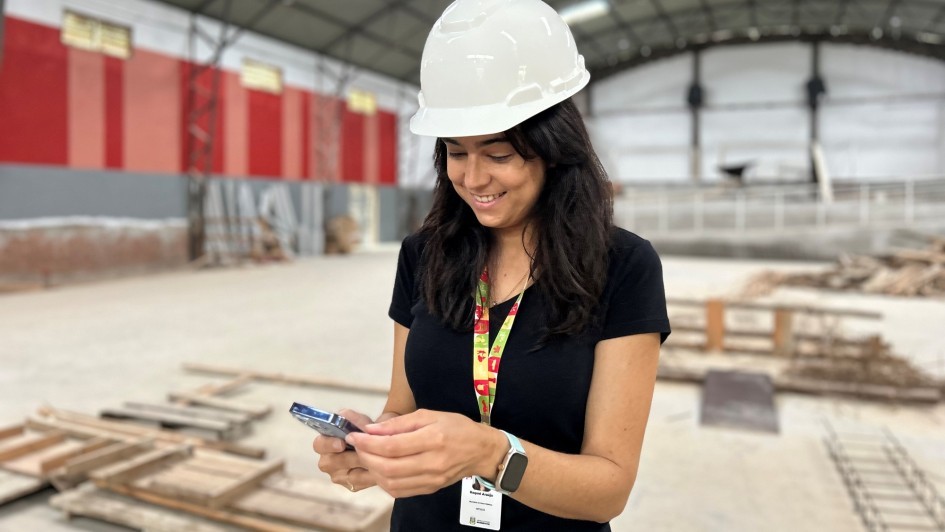
Source: News Portal of the Government of the State of Rio Grande do Sul
The state government, through the Secretariat of Public Works (SOP), is adopting an augmented reality capture system for continuous and remote monitoring of work execution through a technology that uses 360° image recordings. The resource ensures more efficiency in the execution of the works, making it easier for physical progress to be documented constantly, reducing failures, waste, and rework, and is part of a series of innovations that the state government has been implementing to modernize recovery works on public building infrastructure. The secretariat is a pioneer in contracting this technology in the country.
This system uses a cloud platform that gathers documentation, monitoring, and management of construction works. SOP inspectors will use the technology for improvements and maintenance in schools and other state public buildings, strengthening the digitalization of public works monitoring. The model used by the State was developed by the Rio Grande do Sul company Construct IN, headquartered in São Leopoldo.
“Technological updating is one of the pillars we established so that the State could recover the infrastructure of its buildings and reinvest in new structures. Rio Grande do Sul is aligned with the most modern construction practices, which guarantees agility and better results,” says the Secretary of Public Works, Izabel Matte.
“The systematic use of data and visual records changes the way works are monitored because it shifts management from perception to technical evidence. When monitoring is no longer occasional and becomes continuous, inspection gains more clarity on the actual progress of the works, which reduces uncertainties and improves the quality of decisions,” says the CEO of Construct IN, Tales Silva.
Cameras attached to hard hats
Through the system, it is possible to capture 360º images of the construction site, both on the ground and through drones, and link them to the floor plans, with date and location. With a 360º camera attached to a construction hard hat and connected to an app, the entire site can be documented in minutes, depending on the size of the project. The images form a timeline of the entire construction process, facilitating the analysis of the work progress by comparing the records. For this, reference points are used to always capture the same angles.
360º images of the works at Protásio Alves School, in Porto Alegre
Use the mouse to explore the location
The adoption on a state scale occurs after pilot projects showed the advantages of using the tool. With it, it is possible to reduce the differences between what was planned and what is actually being executed. Each visual record is linked to the schedule and the project plans, forming a continuous history of the work, known in engineering as a digital As Built.
For SOP architect Raquel Medeiros Araújo, the system is highly advantageous, facilitating and qualifying the inspection of works, as well as assisting in the comparison between design and execution. “It is very useful because it helps, for example, to visualize something that was not initially noticed. The camera captures everything, from ceiling to floor,” she detailed. Raquel has been using the 360º camera since May last year in the general recovery work of Colégio Protásio Alves, in Porto Alegre. At least once a week, the monitoring of the progress of the works is done with this technology, which will also be taken to professionals who inspect works in the state's interior.
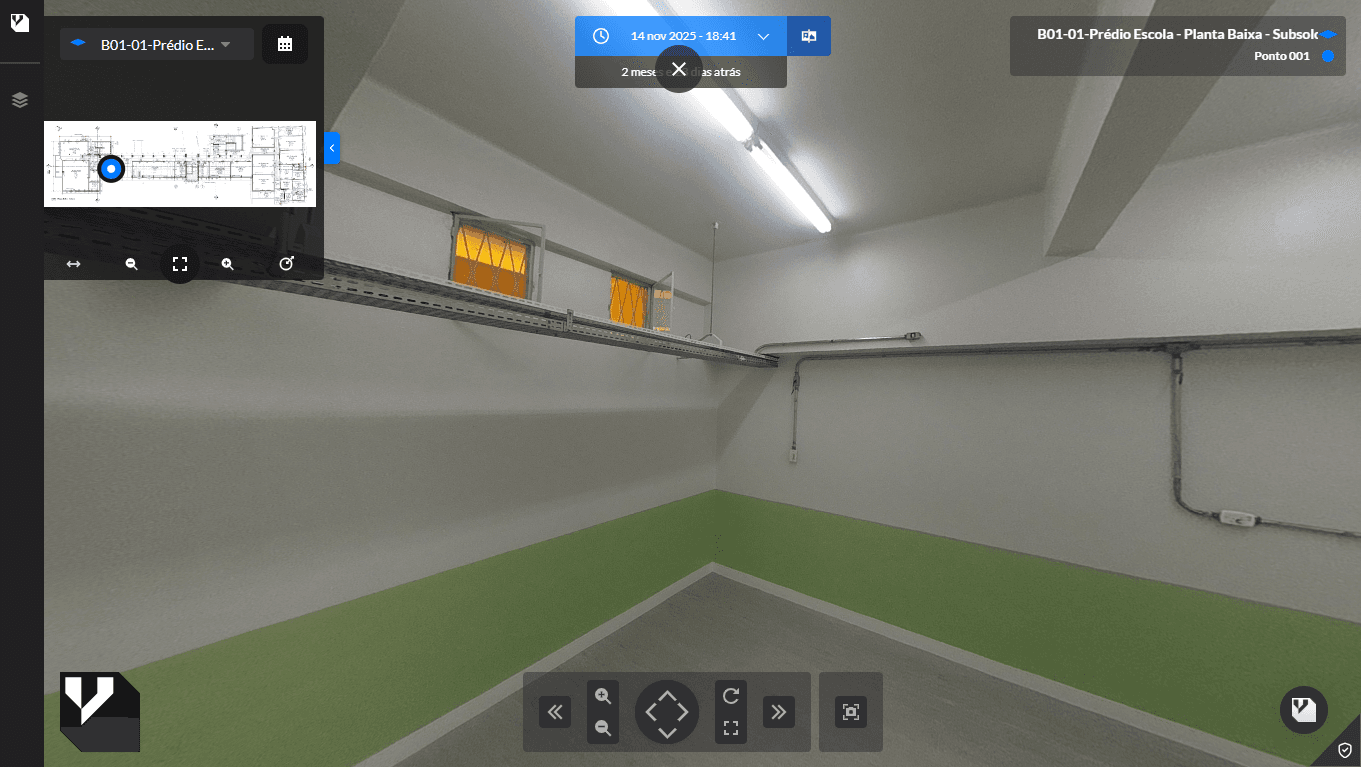
360º records allow monitoring the progress of works in greater detail - Photo: Disclosure Construct IN
Intelligent three-dimensional models
The reality capture system allows bringing together in the same virtual space all the documents and people involved in a project, avoiding information discrepancies. Thus, it can integrate with the Building Information Modeling (BIM) methodology, a collaborative process based on intelligent three-dimensional models that encompass the creation, management, and sharing of information throughout the life cycle of a building. Through BIM modeling, it is possible to visualize spaces and proposed changes in real-time, facilitating decision-making and optimizing processes.
The systematic use of visual records should contribute to more objective decisions and transparency in the investment in public building infrastructure. By documenting each stage of execution, the State gains greater clarity regarding deadlines, costs, and technical compliance of the interventions carried out.
“We are raising the standard of the State's works. Adopting this new technology makes the monitoring of the works more efficient and precise. Meticulous monitoring of each step ensures greater accuracy in construction and, consequently, more qualified and safer buildings,” comments Secretary Izabel Matte.
Text: Ariel Engster/Ascom SOP
Edition: Secom
Source: News Portal of the Government of the State of Rio Grande do Sul
The state government, through the Secretariat of Public Works (SOP), is adopting an augmented reality capture system for continuous and remote monitoring of work execution through a technology that uses 360° image recordings. The resource ensures more efficiency in the execution of the works, making it easier for physical progress to be documented constantly, reducing failures, waste, and rework, and is part of a series of innovations that the state government has been implementing to modernize recovery works on public building infrastructure. The secretariat is a pioneer in contracting this technology in the country.
This system uses a cloud platform that gathers documentation, monitoring, and management of construction works. SOP inspectors will use the technology for improvements and maintenance in schools and other state public buildings, strengthening the digitalization of public works monitoring. The model used by the State was developed by the Rio Grande do Sul company Construct IN, headquartered in São Leopoldo.
“Technological updating is one of the pillars we established so that the State could recover the infrastructure of its buildings and reinvest in new structures. Rio Grande do Sul is aligned with the most modern construction practices, which guarantees agility and better results,” says the Secretary of Public Works, Izabel Matte.
“The systematic use of data and visual records changes the way works are monitored because it shifts management from perception to technical evidence. When monitoring is no longer occasional and becomes continuous, inspection gains more clarity on the actual progress of the works, which reduces uncertainties and improves the quality of decisions,” says the CEO of Construct IN, Tales Silva.
Cameras attached to hard hats
Through the system, it is possible to capture 360º images of the construction site, both on the ground and through drones, and link them to the floor plans, with date and location. With a 360º camera attached to a construction hard hat and connected to an app, the entire site can be documented in minutes, depending on the size of the project. The images form a timeline of the entire construction process, facilitating the analysis of the work progress by comparing the records. For this, reference points are used to always capture the same angles.
360º images of the works at Protásio Alves School, in Porto Alegre
Use the mouse to explore the location
The adoption on a state scale occurs after pilot projects showed the advantages of using the tool. With it, it is possible to reduce the differences between what was planned and what is actually being executed. Each visual record is linked to the schedule and the project plans, forming a continuous history of the work, known in engineering as a digital As Built.
For SOP architect Raquel Medeiros Araújo, the system is highly advantageous, facilitating and qualifying the inspection of works, as well as assisting in the comparison between design and execution. “It is very useful because it helps, for example, to visualize something that was not initially noticed. The camera captures everything, from ceiling to floor,” she detailed. Raquel has been using the 360º camera since May last year in the general recovery work of Colégio Protásio Alves, in Porto Alegre. At least once a week, the monitoring of the progress of the works is done with this technology, which will also be taken to professionals who inspect works in the state's interior.
360º records allow monitoring the progress of works in greater detail - Photo: Disclosure Construct IN
Intelligent three-dimensional models
The reality capture system allows bringing together in the same virtual space all the documents and people involved in a project, avoiding information discrepancies. Thus, it can integrate with the Building Information Modeling (BIM) methodology, a collaborative process based on intelligent three-dimensional models that encompass the creation, management, and sharing of information throughout the life cycle of a building. Through BIM modeling, it is possible to visualize spaces and proposed changes in real-time, facilitating decision-making and optimizing processes.
The systematic use of visual records should contribute to more objective decisions and transparency in the investment in public building infrastructure. By documenting each stage of execution, the State gains greater clarity regarding deadlines, costs, and technical compliance of the interventions carried out.
“We are raising the standard of the State's works. Adopting this new technology makes the monitoring of the works more efficient and precise. Meticulous monitoring of each step ensures greater accuracy in construction and, consequently, more qualified and safer buildings,” comments Secretary Izabel Matte.
Text: Ariel Engster/Ascom SOP
Edition: Secom
Sobre o autor
Isis Gonzaga
Journalist
Jornalista com expertise em Marketing de Conteúdo e Produto, transformando conhecimentos de copywriting em estratégias e lançamentos de sucesso.
cOMPARTILHE NAS REDES
Recomendado para você
carregar mais ↓





Subscribe to our newsletter
Explore nossas soluções
Entre em contato e descubra como a captura da realidade e dados centralizados podem ser a solução para a gestão de suas obras.
