Home > The technologies behind Reality Capture
The technologies behind Reality Capture
Unravel the missing link between planning and execution in construction: understand how Reality Capture integrates management systems and BIM in real time.
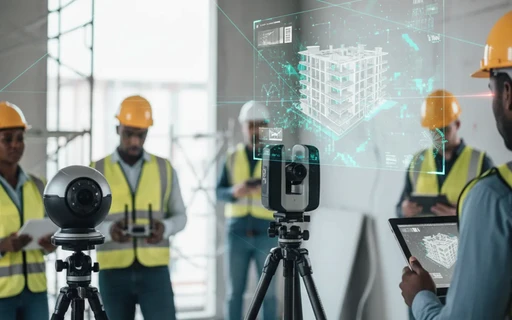
To make an informed and strategic decision, it is crucial to go beyond buzzwords and understand the vast Reality Capture ecosystem. The market offers an arsenal of tools, concepts, and processes, and mastering this language is the first step toward choosing the solution that truly solves your business challenges, rather than just adding complexity.
When technological transformation confronts resistance to change and inefficiency in implementing innovations, knowledge is the key against stagnation. This is the scenario of civil construction in Brazil, which, although showing high adoption of integrated systems and BIM initiatives, still hesitates to recognize Reality Capture as an essential component of modern management. It is not just another tool in your arsenal: it is the link that completes the architecture of construction governance.
Our contribution to this challenge is to facilitate the understanding of this technology, both in its fundamental concepts and in its relationship with others. Given this, it is impossible to ignore the role of Reality Capture in boosting the use of ERPs and BIM, connecting planning, execution, and validation in a single information flow.
In this material, we will dive deep into the universe of job site digitization, organizing knowledge into strategic layers:
Why: the concepts that explain the importance of digitization
How: the hardware and capture methods
What for: how to transform data into accurate decisions
Consider this your guide to navigating the Construction 4.0 landscape and choosing the smartest approach for the Brazilian reality.
Reality Capture: The Missing Link that Connects Planning and Execution
As an engineering leader, you already master the fundamental pillars of modern management. On one side, integrated systems — whether robust ERPs or structured spreadsheets — that organize financial and operational resources. On the other, the BIM methodology, which establishes the digital master plan of construction with millimeter precision.
These are tools that define what should happen. But true governance arises from a third pillar, the one that answers the critical question that neither management systems nor BIM can answer in isolation: what is actually happening on the construction site, at this very moment?
This is the blind spot that Reality Capture illuminates, transforming construction management from an exercise in trust to an operation based on concrete evidence.
To understand this strategic integration, imagine your construction management as an airport operations center. Each system has a critical function in the operation, but it is their synchronized integration that ensures all "flights" (construction activities) take off and land safely, efficiently, and within the planned schedule.
Management Systems: The Operational Control Tower
The management system works like an airport control tower, handling materials, labor, equipment, and time — just like a control tower that keeps the flight network safe and efficient.
Its strength lies in the command and control of operational flows, but just as a control tower cannot physically inspect each aircraft, the management system processes measurements, manages inventory, and authorizes raw material deliveries, but does not physically inspect execution on the ground. It authorizes the "landing" (payment) but does not verify the actual conditions of the "runway" (job site).
BIM: The Master Flight Plan
BIM is like the detailed flight plan - it contains the entire planned route, technical specifications, execution schedule, and expected performance parameters. It is the complete digital representation of "how the work should be executed", essential for planning, compatibility, and coordination among teams.
However, even the most detailed flight plan is a projection based on ideal conditions. The BIM methodology defines the planned route, but it does not inform about the actual meteorological conditions or unexpected turbulence along the execution "path".
Reality Capture: GPS and Real-Time Telemetry of the Work
If the management system is the control tower and BIM is the flight plan, Reality Capture is the weather radar and telemetry system that continuously informs the actual conditions of each "flight" in progress.
For Management Systems, it provides Validation Intelligence: Reality Capture delivers the visual evidence that connects the investment to the physical outcome. Before authorizing a "landing" (payment), you can confirm whether the conditions of the "runway" (execution) are as planned.
For BIM, it enables Execution Intelligence: Continuously monitors whether the "actual route" is following the "flight plan", identifying "turbulence" (deviations) before they become "emergencies" (costly problems that require rework).
In a high-performance construction project, having a resource plan (ERP) and a detailed map (BIM) is vital. But it is the real-time GPS of Reality Capture that ensures the plan is followed precisely, transforming construction management into a science of precision.
This integrated triad is no longer an option: it is the mandatory architecture for competitive and fail-proof civil construction. The difference between construction companies that thrive and those that merely survive is increasingly in this ability to connect planning, execution, and real-time validation.