Home > Decoding the Reality Capture Universe
Decoding the Universe of Reality Capture
Amid disinformation and confusion of concepts, the path to the benefits of Reality Capture begins with clarity, even if that means reinforcing the obvious.
High-precision LiDAR, dense point clouds, computational photogrammetry, and, in parallel, the perception of high investments, complex technical certifications, extensive training for teams, robust computing infrastructure, expensive software licenses...🤯 Elements of this kind are recurrent on the list of beliefs about reality capture.
This narrative of high complexity and cost is, without a doubt, one of the biggest bottlenecks to the adoption of the technology. Leaders hesitate not because of lack of interest, but because they believe that the barrier to entry is too high. However, this is only one side of the coin. In addition to the perception of complexity, there is another equally significant noise: conceptual confusion.
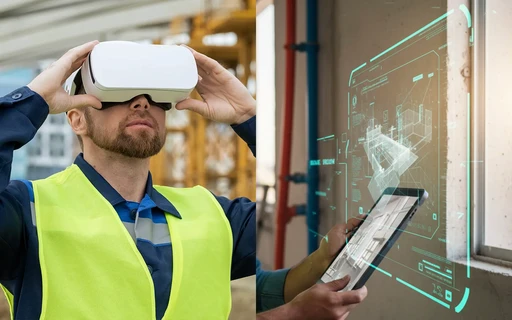
The construction industry has a remarkable peculiarity: historically, it absorbs mature technologies from other sectors, adapting them to its specific needs. In the case of immersive technologies, this has created a conceptual overlap between reality capture, augmented reality, and virtual reality.
Although the terms are related, their applications and purposes are completely different. If this distinction seems obvious to some, it is crucial to clarify it so that it becomes universal knowledge. After all, this is our purpose here: to eliminate all barriers to understanding the benefits and accessibility of reality capture.
Removing misconceptions is the first step toward fully understanding the transformative potential of this technology. We will decode each one of them and then present a definitive synthesis that differentiates these innovations.
Unraveling the Confusion: The Universe of Extended Reality (XR) and Reality Capture
The conceptual confusion between Reality Capture and the terms of the Extended Reality (XR) universe — such as Virtual Reality (VR) and Augmented Reality (AR) — is common even among experienced professionals, but their purposes are fundamentally different. It is crucial to clarify them to prevent misconceptions from hindering the adoption of technologies that can revolutionize construction management.
This distinction is not just semantic — it defines completely different strategies, investments, and results for your company.
Virtual Reality
Virtual Reality (VR) is a technology that transports the user to a completely artificial three-dimensional digital environment, replacing their perception of the real world. Through VR headsets or glasses, the user is immersed in this new environment, being able to explore and interact with it. In civil construction, its applications are focused on simulation and visualization, such as:
Client Presentations: VR allows clients and investors to "walk" through a project before the first stone is even laid. This provides a spatial perception and an emotional experience that traditional models and renders cannot replicate.
Safety Training: virtual construction sites can be created to simulate risk scenarios, allowing teams to practice safety procedures without any exposure to real dangers.
VR is fundamentally a technology of creation and simulation. It does not capture existing reality, but rather constructs alternative realities for specific purposes.
Augmented Reality (AR)
Augmented Reality overlays digital information or objects onto the visible space, usually through the camera of a smartphone, tablet, or special glasses. Unlike VR, it does not isolate the user from the real environment, but rather enhances it with contextualized digital data.
In construction, AR is used for:
Overlay of BIM models: allows visualizing how planned structures fit into the real environment, identifying conflicts before execution.
Guided inspections: technicians can see information about hidden systems (pipes, electrical wiring) overlaid on the physical structure.
Team coordination: facilitates communication among professionals by showing contextualized visual instructions directly at the job site.
Visualization of Hidden Infrastructure: AR can display the exact location of pipes, ventilation ducts, and electrical wiring inside walls and under floors, which is invaluable for maintenance teams and to prevent accidental damage during renovations.
On-Site Project Presentation: the technology allows showing a client how a new building will look on an empty lot or how different finishing options will look in an already constructed space, facilitating decision-making.
AR is an information enrichment technology. It takes what already exists physically and adds layers of digital data to improve understanding and decision-making.
making.
And what about Extended Reality (XR)? The Term that Unites Everything
In addition to detailing VR and AR, it is important to know the term that encompasses both: Extended Reality (XR). Think of XR as a broad spectrum of immersive technologies.
At one end of this spectrum, we have Virtual Reality (VR), which isolates us from the real world. At the other end, we have Augmented Reality (AR), which integrates with our world. XR, therefore, is not a third technology, but rather the field that studies and develops all forms of interaction between the real and digital worlds.
For a construction manager, understanding what XR is is important because new tools and devices (such as the Microsoft HoloLens or Apple Vision Pro) are increasingly merging the features of AR and VR. They operate across the entire "XR spectrum," becoming hybrid and extremely powerful solutions.
The differential of Reality Capture
Unlike Virtual and Augmented Reality, Reality Capture does not create fictional worlds or overlay digital information onto our view. Its primary function is to "read" the real world: to digitize it as it is, creating a faithful and accurate database of the built environment. Although the act of capture is a one-way process (physical → digital), it is the raw material for the most dynamic applications.
Through equipment such as 360° cameras, drones, and laser scanners (LiDAR) associated with technology, it documents the actual conditions of the project at any specific moment.
This digitization goes far beyond a simple photograph. It generates a collection of spatial and visual data that serves as the foundation for the Digital Twin — a virtual, dynamic, and interactive replica of the built asset. This model can be measured, analyzed, annotated, and shared, establishing a single source of truth for all stakeholders.
Although it has applications in diverse fields, from archaeology to medicine, its role becomes truly transformative in the Architecture, Engineering, and Construction sector.
In civil construction, Reality Capture is applied for:
Continuous documentation: Create a visual, chronological, and navigable history of the project's progress.
Remote quality control: Enable detailed inspections without the need for physical travel.
Measurement validation: Provide irrefutable evidence for payment approvals and dispute resolution.
BIM integration: Compare what was built with what was designed, identifying discrepancies in a timely manner for corrections.
Creation and updating of Digital Twins: Provide the geometric and visual ("as-built") foundation for the virtual replica of the asset, which will then be enriched with operational data to enable real-time simulations and monitoring.
Reality Capture is a documentation and evidence technology. It creates what we could call the project's digital source of truth, serving as a reliable basis for all decisions related to the construction work and as a starting point for the operational digitization of the asset.
The synthesis: How do XR Technologies Connect to Reality Capture?
Extended Reality (XR) spectrum technologies and Reality Capture (RC) are different, but their transformative potential emerges precisely when they connect.
While XR experiences (such as VR and AR) create or modify our perception of reality, Reality Capture "grounds" them, connecting them to the physical world with precise job site data.
By using this "raw material," AR and VR experiences gain immersion and contextual accuracy, elevating them from design tools to powerful instruments for management, verification, and quality control.
For the construction manager, understanding this distinction is strategic. While XR spectrum technologies (VR and AR) are powerful process support tools (presentation, training, visualization), Reality Capture is an operational and strategic management technology, which transforms how progress is monitored, documented, and validated.
This is why it has become the backbone of digital transformation in construction: not just a complement to existing processes, but the foundation for effective management.